Used Electric Car: Battery Passport Arrives 2027
From 18 February 2027 every electric car battery sold in Europe will need a digital passport showing its health, charge cycles and carbon footprint. Here is what that already means for anyone buying or selling a used EV in Italy, now that the 2026 national incentive for new cars has run dry.
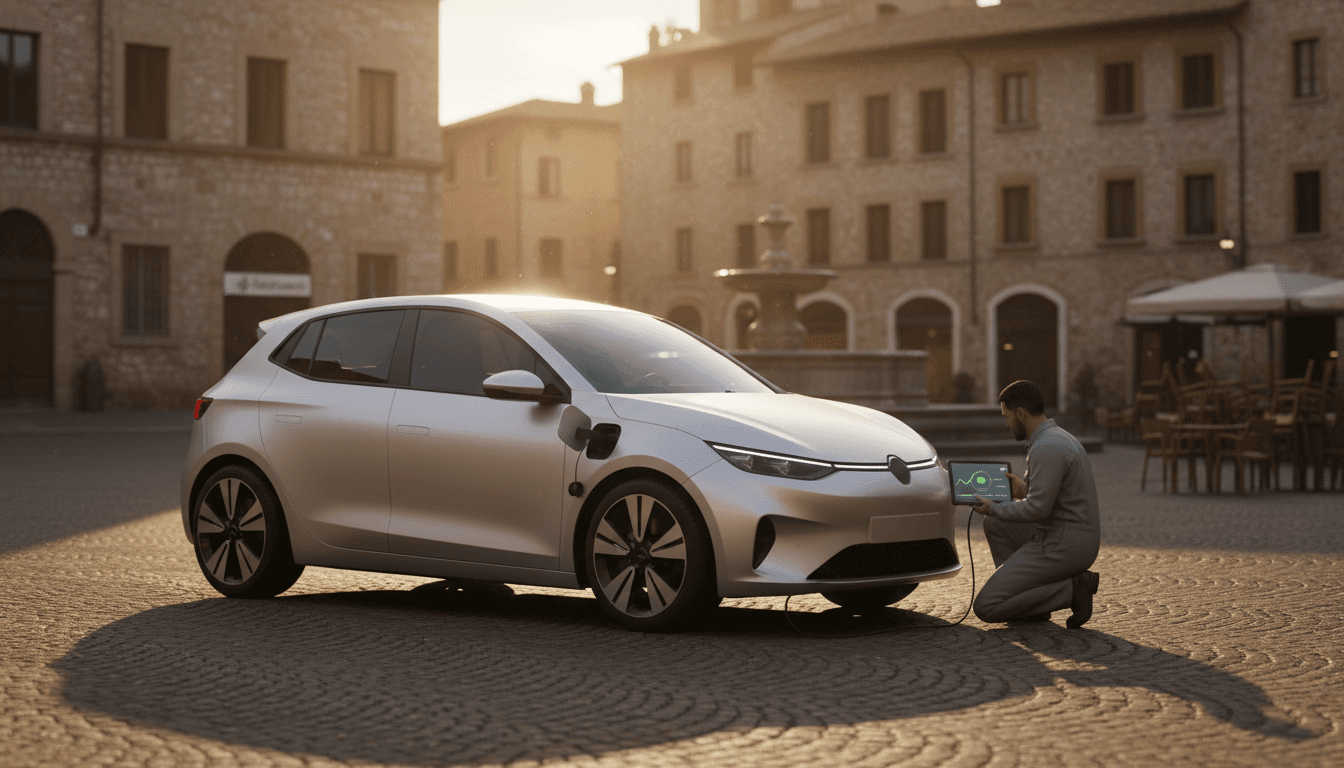
The countdown to the battery passport has started
Anyone following the Italian electric-car market has spent the last few months hearing about a change that will arrive quietly but hit the used market hard: the Battery Passport. EU Battery Regulation 2023/1542 becomes fully applicable to electric-vehicle batteries, light-transport batteries and industrial batteries above 2 kWh from 18 February 2027 [1][2]. From that date, every battery placed on the European market must come with a digital passport accessible via QR code, covering chemical composition, raw materials, declared carbon footprint, recycled-content share, remaining usable capacity and the number of charge cycles completed [1].
For anyone buying or selling a used EV in Italy today, this is not a technical footnote. In just over a year, battery health will stop being optional information a seller can choose to share, and will become a traceable, verifiable data point available to anyone with a legitimate interest, regulators included [2]. A seller who cannot already show at least a battery-health figure is going to look markedly less transparent to an informed buyer.
Why the used-EV market makes sense right now
The timing is not a coincidence. The PNRR funds managed by Italy's Ministry of Environment for new electric-vehicle purchases ran out back in October 2025, and in March 2026 the Ministry of Enterprises and Made in Italy officially confirmed the national ecobonus will not be renewed for category M1 passenger cars, calling it ineffective at national scale [3][4]. Only a handful of regional schemes remain active — Lombardy, Veneto and Piedmont, for instance, still offer top-up contributions of 2,000 to 4,000 euros, but funds are limited and rules differ region by region [4].
With new cars staying expensive and no national discount to soften the blow, the used-EV market has become the realistic path into electric driving for most Italian buyers. That is exactly why battery condition now matters so much: buying a used EV without knowing how its battery is actually holding up is a risk that, with the digital passport just over the horizon, makes less and less sense.
SOH: the number that matters more than mileage
The key metric is State of Health, or SOH: the percentage of usable capacity a battery still has compared with when it was new. A car with 60,000 km and a 94% SOH is often a smarter buy than one with 40,000 km and an 85% SOH, because degradation depends far more on how the battery was charged and stored than on raw mileage [5]. As a rule of thumb, an SOH above 90% is excellent, while capacity dropping below roughly 70-75% starts to visibly affect real-world range and resale value [5].
Until the digital passport becomes mandatory, the most reliable way to know a car's SOH today is to request an official certificate from the manufacturer's own service network: brands including Tesla, Volkswagen ID., Mercedes EQ, BMW and the Hyundai-Kia group offer this for roughly 50 to 150 euros, often bundled with a broader pre-purchase inspection [5]. That is a small price against the risk of buying an already-compromised battery.
Battery warranty: what to expect today
The most common warranty formula in 2026 is still 8 years or 160,000 km, with some manufacturers pushing that mileage cap to 192,000 or even 240,000-250,000 km on specific models or markets [5]. The clause worth reading carefully is the intervention threshold: most manufacturers treat degradation as normal wear as long as the battery holds at least 70% of its original capacity, and only open a warranty repair or replacement claim once it drops below that [5]. On a used EV, checking how many years or kilometres of warranty remain, and whether that warranty transfers to a new owner, is every bit as important as an engine service history on a petrol car.
The used-EV sweet spot
Buyers looking to optimise the price-to-risk ratio should look at electric cars aged 2 to 4 years with 50,000-80,000 km on the clock and an SOH above 90%: these typically sell for around 35% less than an equivalent new model, still carry 4-6 years of remaining battery warranty, and already come with modern DC fast-charging hardware [6]. Below that age band the price advantage over new narrows sharply, especially now that the national ecobonus is gone, while older cars call for closer scrutiny of SOH and remaining warranty before making an offer.
Insurance and running costs to budget for
The insurance picture in 2026 is less straightforward than it looks: some data point to average EV premiums around 600 euros, above the general motor-insurance average, largely due to higher bodywork repair costs; other insurers, by contrast, now apply dedicated discounts of 10 to 30% to BEVs to win over customers [7]. The outcome depends heavily on the insurer and where you live, so it is always worth comparing several quotes before buying, and for EVs worth more than 30,000 euros it is worth checking whether dedicated battery cover is available.
The practical checklist before you sign
Before closing on a used EV, always ask for: the most recent SOH certificate from the official network or a qualified independent centre; the number of years and kilometres of battery warranty still valid, and whether it transfers; the car's charging history, favouring cars charged mostly on AC rather than constant DC fast-charging, which stresses the cells more; and a real insurance quote before locking in your budget. Sellers, for their part, would do well to get a battery health certificate now rather than later — in a year it will be the norm, but showing one today already sets a listing apart in the eyes of a careful buyer, whether the sale happens privately or through a marketplace like VendiVoce.
Sources
- Vaielettrico, Battery Passport: l'Europa certifica la salute delle batterie, https://www.vaielettrico.it/battery-passport-leuropa-certifica-la-salute-delle-batterie/
- Motori.it, Batterie auto elettriche, dal 2027 arriva il QR code: cosa cambia, https://www.motori.it/batterie-auto-elettriche-dal-2027-arriva-il-qr-code-cosa-cambia/
- alVolante.it, Ecobonus 2026, fondi gia' esauriti. Cosa fare se sei rimasto senza, https://www.alvolante.it/news/ecobonus-2026-fondi-gia-esauriti-cosa-fare-se-sei-rimasto-senza-412307
- Frattin Auto, Incentivi Auto 2026: Niente Bonus sul Nuovo?, https://frattinauto.it/blog/incentivi-auto-2026/
- Auto Trade & Logistics, Garanzia batteria auto elettrica: tutto su copertura e SoH, https://autotradeandlogistics.it/garanzia-batteria-auto-elettrica-tutto-su-copertura-e-soh
- Auto Supermarket, Auto elettrica usata: quale comprare nel 2026, https://autosupermarket.it/magazine/compravendita-auto/auto-elettrica-usata-quale-comprare
- Guida Auto Elettrica, Assicurazione Auto Elettrica 2026: Costi, Sconti e Quale Scegliere, https://www.guidautoelettrica.it/guide/assicurazione-auto-elettrica
Further reading
- Battery Passport: l'Europa certifica la salute delle batterie — Vaielettrico
- Batterie auto elettriche, dal 2027 arriva il QR code: cosa cambia — Motori.it
- Ecobonus 2026, fondi gia esauriti. Cosa fare se sei rimasto senza — alVolante.it
- Incentivi Auto 2026: Niente Bonus sul Nuovo? — Frattin Auto
- Garanzia batteria auto elettrica: tutto su copertura e SoH — Auto Trade & Logistics
- Auto elettrica usata: quale comprare nel 2026 — Auto Supermarket
- Assicurazione Auto Elettrica 2026: Costi, Sconti e Quale Scegliere — Guida Auto Elettrica
Related articles
600kW Chargers: What It Means for a Used EV
Electra is bringing 600 kW charging to the A4 and A10 motorways by 2027. But fast charging stresses batteries, here is what to actually check before buying a used EV.
Charging an EV at Night: How Much You Really Save
With September 2026 prices in hand: home charging in the F2/F3 time bands can save up to 826 euros a year versus petrol. But without a parking spot for a wallbox, the math changes completely.