Charging an EV at Night: How Much You Really Save
With September 2026 prices in hand: home charging in the F2/F3 time bands can save up to 826 euros a year versus petrol. But without a parking spot for a wallbox, the math changes completely.
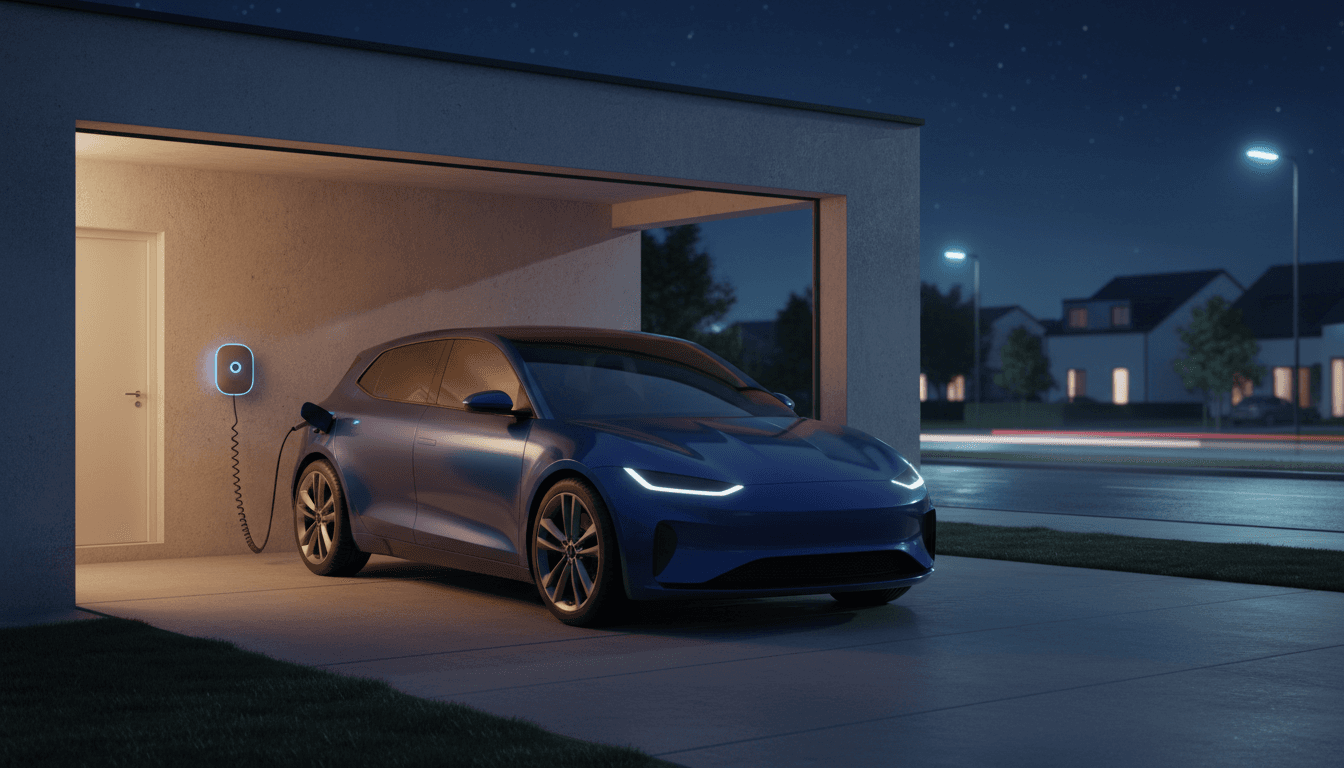
How much you really save charging at night
It's one of the most searched questions among people who own, or are about to buy, an electric car: does charging at night actually pay off? With September 2026 numbers in hand, the answer is yes, but only under two precise conditions: you charge at home, and your electricity contract has time-of-use rates. Without both, night charging on its own saves you nothing.
A comparison published on September 14, 2026, based on average fuel prices recorded in the Lazio region on September 11, spells out the gap: with home charging at 0.25 euros per kWh, driving 100 km in the city in an EV costs about 3.25 euros, against 11.51 euros for petrol, 10.90 for diesel and 6.09 for LPG. Over 10,000 km a year, home charging saves roughly 826 euros compared with petrol, 765 euros compared with diesel, and 284 euros compared with LPG. Drivers covering 25,000 km a year or more see the savings comfortably clear 2,000 euros.
The F1, F2, F3 time bands: what they actually change
The night-time saving isn't a figure of speech: it depends on the time bands set by Italy's energy regulator ARERA under resolution 181/06, which are identical for every supplier (only the price per kWh in each band changes, never the hours). Band F1, peak, runs Monday to Friday from 8am to 7pm. Band F2, mid-level, covers Monday to Friday 7-8am and 7-11pm, plus all of Saturday from 7am to 11pm. Band F3, off-peak and the cheapest, covers every night from 11pm to 7am, all of Saturday after 11pm, and the whole of Sunday and public holidays. With a well-chosen two- or three-band contract, shifting charging into F2 or F3 can cut the energy cost by 20 to 40 percent compared with charging during a weekday afternoon. Recent wallboxes come with a scheduling function built specifically for this: set the start time once, and the system waits for the F3 window on its own, no need to get up at midnight to plug in.
Home, public charger or the petrol pump: the real comparison
The gap widens further once you look at public charging. As of September 2026, Italian public chargers cost on average about 0.62 euros per kWh on AC and 0.74 euros per kWh on DC or HPC fast charging, with prices across operators ranging from roughly 0.47 to 0.94 euros per kWh. A 60 kWh top-up that costs about 15 to 16 euros at home can top 40 euros at a fast charger. In cost per 100 km, that means going from 3 to 5 euros for overnight home charging to 8 to 11 euros for public AC charging, and 11 to 16 euros for DC or HPC fast charging, a level that approaches or exceeds a petrol car's running cost. Subscriptions from the main operators can cut the per-kWh price by 30 to 40 percent for people who charge in public often, but they never fully close the gap with a home socket.
The real obstacle isn't the clock, it's the parking spot
This is where the topic connects directly to anyone weighing a used electric car: every saving calculated above assumes you can install a wallbox where you normally park. Someone living in a condominium with no assigned parking, or with a garage too far from the meter, ends up charging almost exclusively in public, edging closer to petrol-level running costs instead of cutting them in half. The good news is that the law favors installing one. Article 1122-bis of the Italian civil code, introduced by law 134/2012, gives every condominium owner the right to install charging infrastructure at their own expense, without needing the building assembly's prior approval. It's enough to notify the building administrator by registered letter or certified email, attaching a layout of the planned work and the installer's details; if the assembly doesn't rule within 90 days, the owner can proceed anyway, barring genuine technical objections tied to safety or the building's architectural character. A review of recent case law, published in June 2026, confirms that a single owner's right prevails over building-level resistance in the large majority of disputes.
What to check if you're buying or selling a used EV
If you're considering a used electric car, the first calculation isn't the asking price, it's where you'll actually charge it every night. A private garage or an assigned condominium spot where you can fit a wallbox is worth more, over a few years, than a discount on the sticker price: it's the difference between paying 3 to 4 euros or 10 to 12 euros per 100 km. Ask the seller whether the car comes with a home wallbox already installed, what kind of electricity contract they run, and whether they ever hit resistance getting condominium approval. These are details that rarely make it into a listing but matter as much as the number on the odometer.
If you're the one selling, the same logic runs in reverse: mentioning, ideally out loud in your walk-around video, that the car was charged overnight at the cheaper rate and what the real monthly top-up cost was gives an undecided buyer something far more concrete than a vague economical in the description. A state incentive for installing home chargers, refinanced in 2026 for both private owners and condominiums, can also be a useful talking point for someone moving from a petrol runabout to their first used EV.
The takeaway
Charging at night pays off, but not by magic: it pays off because ARERA's F2 and F3 time bands make Italian electricity cheaper away from peak hours, and because doing it at home costs a third or less of public charging. For anyone shopping the used market, the real dividing line isn't electric versus petrol, it's whether you have somewhere to put a wallbox. With one, the math almost always favors the EV. Without one, it's worth redoing the sums before you sign anything.
Further reading
- Auto elettrica vs benzina, risparmi fino a 826eu (ma non sempre) — idealista/news
- Fasce orarie luce F1, F2, F3: orari, prezzi e quale conviene (2026) — Bolletta Energia
- Costo ricarica auto elettrica settembre 2026: tariffe e euro/kWh — Elettrico per Tutti
- Bonus colonnine 2026 per privati e condomini, importi e quando arriva — idealista/news
- Contenzioso wallbox condominio: le sentenze e gli orientamenti 2026 — Passaggio Elettrico
- Colonnina ricarica condominio: diritti, iter e costi 2026 — DML Idee
Related articles
600kW Chargers: What It Means for a Used EV
Electra is bringing 600 kW charging to the A4 and A10 motorways by 2027. But fast charging stresses batteries, here is what to actually check before buying a used EV.
Used Electric Car: Battery Passport Arrives 2027
From 18 February 2027 every electric car battery sold in Europe will need a digital passport showing its health, charge cycles and carbon footprint. Here is what that already means for anyone buying or selling a used EV in Italy, now that the 2026 national incentive for new cars has run dry.