Electric 125 Scooter: Prices, Range and License
What an electric 125 scooter costs, how far it really goes and which license you need: prices for models like the Piaggio 1, Niu, Vespa and BMW CE 04, nominal versus peak power, and used-buying checks.
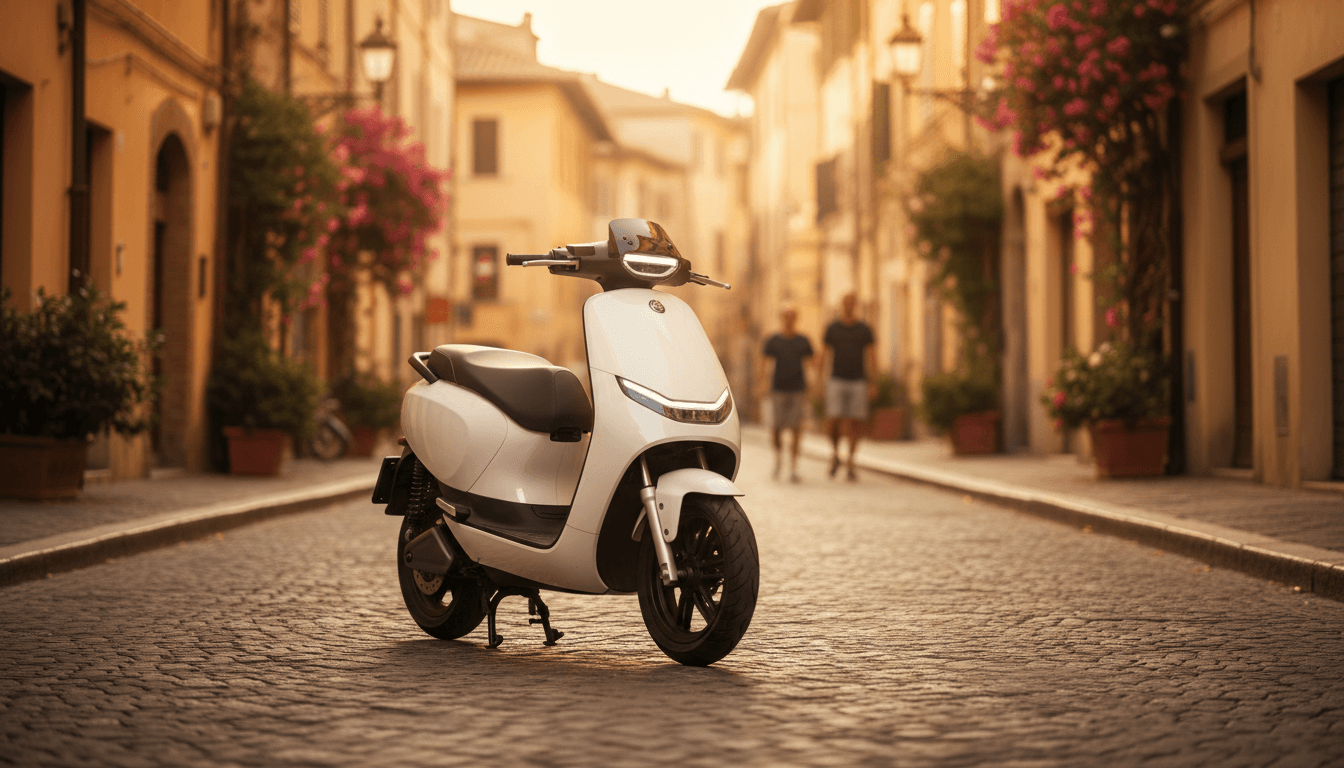
Anyone searching for an electric 125 scooter in Italy wants three answers: what it costs, how far it goes and which license it needs. The answers vary a lot from model to model, because the 125 label covers machines with very different power, batteries and prices. This guide puts the numbers in order, cites the sources we consulted, and adds what to check if you buy one second-hand.
What 125 means for an electric scooter
An electric motor has no displacement, so the term is 125-equivalent: an L3e vehicle with performance comparable to a 125 cc petrol engine. What matters for the license is power: the limit is 11 kW with a power-to-weight ratio of no more than 0.1 kW/kg. Note that many spec sheets list two figures, nominal (continuous) power and peak power. The Niu MQi GT Evo, for instance, is quoted at about 9 hp peak and 6.7 hp continuous, while the Silence S01+ claims 7.5 kW nominal and 11.5 kW peak.
There is also the L1e moped class, capped at 45 km/h. Some models, such as the Askoll XKP or the electric Vespa, come in two versions: a 45 km/h one and a 70 km/h 125-equivalent one. Always check which one you are looking at before you sign.
Which license you need
According to Quotidiano Motori's 2026 guide, the A1 license can be obtained at 16 and covers scooters up to 11 kW. A B license allows a 125 scooter only through an Italian exemption: the license must have been issued in Italy, the rider must be at least 18, and the scooter must stay within 11 kW. The exemption is valid only in Italy, so abroad most European countries require at least an A1.
In practice: with an Italian B license you can ride an electric 125 scooter around town with no extra exam. If you are under 18, or plan to ride outside Italy, you need the A1.
What electric 125 scooters cost
List prices vary widely. AutoScout24's July 2025 overview gives these orders of magnitude, all indicative starting prices:
- Piaggio 1: about 2,899 euros, Piaggio 1 Active about 3,299, Piaggio 1+ about 3,699.
- Yamaha NEO'S EV: about 3,299 euros; Honda EM1 e: about 3,190.
- Askoll XKP: about 5,390 euros; Niu MQi GT Evo: about 5,799.
- Vespa Elettrica 70: about 7,499 euros; SEAT Mò eScooter 125: about 7,490.
- BMW CE 04: about 13,500 euros, the benchmark for premium performance.
Cleanrider's January 2026 comparison, based on French prices, shows similar values: Segway E250S at 3,999 euros, Niu NQiX 500 at 4,499, Vmoto Super Soco CPX Pro at 4,790, Silence S01+ at 6,670 and Pink Fly Phase 3 at 7,390. Treat these as ballpark figures: in Italy the final price depends on the dealer and current promotions.
One useful detail: AutoScout24 notes that the 2025 state incentives for scooters ended in May. Before counting on a discount, check that one is actually active today.
Range: claimed versus real
Claimed range runs from about 70 km to over 130 km. Examples from the sources: Vespa Elettrica 70 about 80 km, Niu MQi GT Evo 70-75 km, SEAT Mò eScooter 125 about 137 km, BMW CE 04 between 100 and 130 km depending on version, Silence S01+ up to 133 km in Eco mode, Pink Fly up to 150 km.
These figures are measured under favorable conditions. Cleanrider itself warns that range depends on riding style, rider weight and route. A prudent rule: count on roughly 70-75 percent of the claimed value if you often ride at top speed, and somewhat more in pure city traffic. For a commuter doing 20 km a day, almost any model on the list is more than enough.
Removable or fixed battery
AutoScout24 notes that most of the models it compares have a removable battery, the exception being the Vespa Elettrica. This matters in practice: if you live in an apartment block without a garage, you can carry the battery indoors and charge it from a normal socket. With a fixed battery you need to be able to charge the scooter where you park it.
Buying second-hand: what to check
The used electric scooter market is young and prices fall fast, which can be an opportunity. The essential checks:
- Battery health: ask for the number of charge cycles and a real-world range test. A degraded battery is the biggest cost you can face.
- Remaining warranty: check whether the battery warranty is still valid and transferable to the new owner.
- Category on the registration document: confirm whether it is L1e (45 km/h) or L3e (125-equivalent), since it changes the license and performance.
- Charger and spare battery: they should be included and working.
- Ownership transfer: it is handled like any other motorcycle, so make sure the seller is the registered owner.
How to choose: three profiles
For city use on a tight budget, models around 3,000-4,000 euros such as the Piaggio 1 Active or Segway E250S cover daily trips well. For longer commutes, look at models claiming over 100 km such as the Silence S01+ or SEAT Mò. For premium performance and finish, the BMW CE 04 is the most expensive option, though its limited version can still be ridden with an A1 or B license.
Bottom line
An electric 125 scooter makes sense if your trips are urban, you have somewhere to charge, and your license is compatible. Set a budget, check the category on the registration document, distrust brochure range figures and, if buying used, insist on seeing the battery state. That avoids the most common surprises.
Further reading
- AutoScout24, Scooter elettrici: i migliori modelli e i prezzi, 16 July 2025.
- Quotidiano Motori, Patente A1, B o A: chi può guidare uno scooter 125, 2026.
- Cleanrider, Meilleurs scooters électriques 125, 18 January 2026.
Further reading
Related articles
Used scooter: what to check before you buy
How to choose a used scooter (Vespa, Honda SH, Beverly): paperwork and frame number, belt and variator, test ride, transfer costs and price negotiation.
Electric 125 scooter in Italy: licence, costs, worth it?
B or A1 licence, purchase price, annual costs of a petrol 125 and a worked example of charging and break-even: when an electric 125 scooter really pays off.