Electric 125 scooter in Italy: licence, costs, worth it?
B or A1 licence, purchase price, annual costs of a petrol 125 and a worked example of charging and break-even: when an electric 125 scooter really pays off.
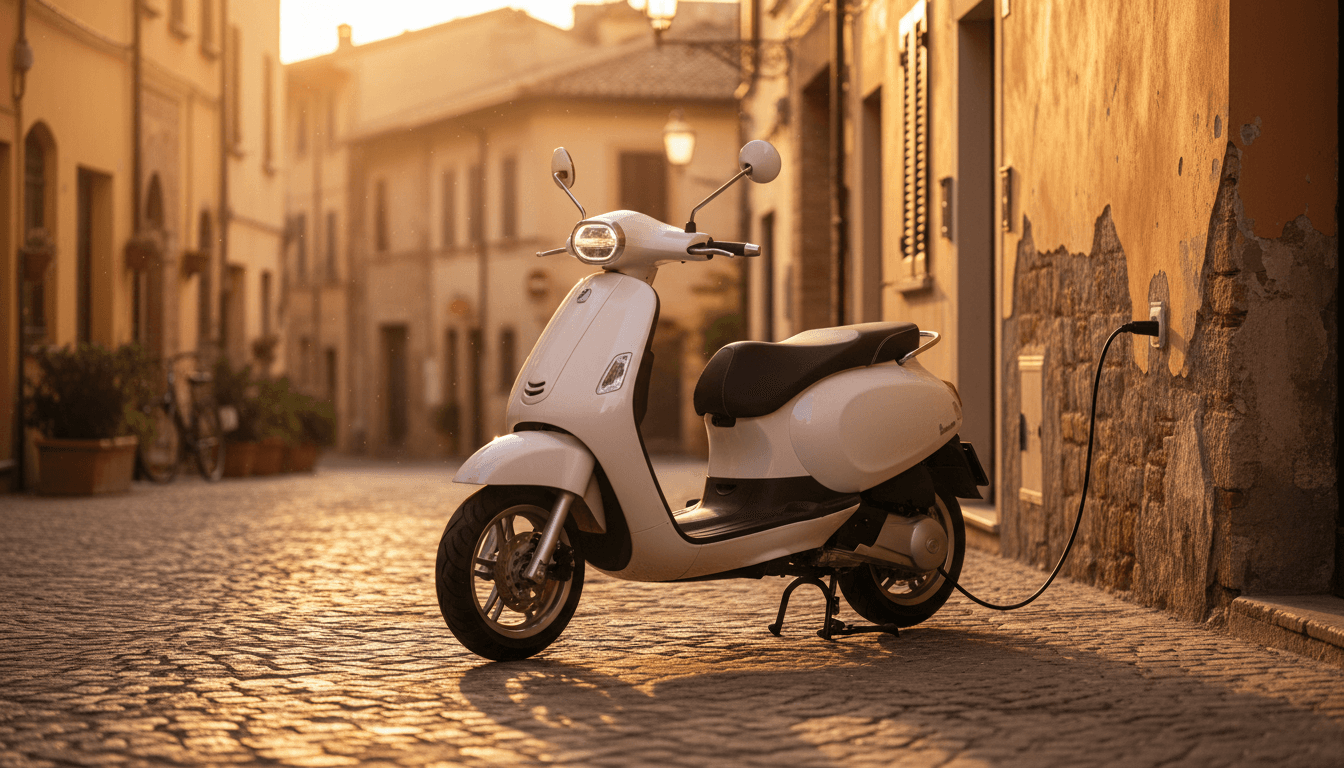
The electric 125 scooter is the option many car-licence holders in Italy eye with curiosity: no petrol, no oil changes, no fumes in the city centre. But it costs more to buy, so do the fuel savings really make up the difference? Here is a licence check, the real running costs and an honest break-even calculation, using data available in November 2026.
What a 125-equivalent electric scooter is
Electric scooters have no engine capacity, so the market talks about 125 equivalents: L3e-A1 vehicles with power within the A1 category limits. One example is the SEAT MÓ 125, declared at 133 km of range with a 5.6 kWh lithium-ion removable battery weighing about 40 kg. Another is the Nerva Spark, a 125 equivalent with 4.5 kW nominal and 7 kW peak power and a removable LFP battery.
Do not confuse it with the 45 km/h electric moped, which has different rules, plates and licence requirements: that is a separate market, covered in our guide to electric scooters without a licence.
Which licence you need
The rule is the same as for petrol 125s. The A1 licence can be taken from age 16 and covers up to 125 cm³, 11 kW and 0.1 kW per kg. The B car licence, from age 18, is valid for category A1 under the Italian Highway Code, with no extra exam. The equivalence only applies in Italy: abroad you need at least an A1.
Note that a learner's permit is not enough to ride a 125; you need the B licence itself. If you pass the A1 test on an automatic you get code 78 and can only ride automatic scooters and bikes, but an electric scooter is automatic anyway, so this limit does not bite.
Purchase price
Here the electric loses round one. The SEAT MÓ 125 is listed at 4,760 euros, while a quotidianomotori roundup of petrol 125 scooters under 4,500 euros lists nine models, with the cheapest Kymco at 2,290 euros. That is a price gap of roughly 300 to over 2,000 euros depending on the rival, and registration costs are on top of list prices.
On the used market the gap narrows, but the checks differ: for electrics, battery health matters; for petrol, service history. A PRA search and a battery check with the manufacturer's diagnostics are worth more than any discount.
Annual costs of a petrol 125: the baseline
You need a reference. According to quotidianomotori, a 125 scooter ridden 5,000 km a year, in Northern Italy with a top insurance class, costs about 625 euros a year. The items: liability insurance 90 to 200 euros (120 in their table), road tax 20-30 euros (25), annual service 80-150 euros (100), fuel about 300 euros at 1.78 euros per litre and roughly 30 km per litre, and tyres 80 euros a year as an amortised share.
An electric scooter changes two of those lines: fuel and servicing. For the others, insurance in particular, get real quotes, because we found no reliable data for electrics.
Charging cost: a worked example
Energy cost is simple: battery kWh times the electricity price. Assume a home price of 0.30 euros per kWh, an indicative figure to replace with the one on your bill. A 5.6 kWh battery therefore costs about 1.70 euros for a full charge.
Declared range rarely matches real use, so we prudently assume 90 km per charge. For 5,000 km you need about 55 charges, roughly 310 kWh, so around 90 euros a year. Against 300 euros of petrol, the fuel saving is about 210 euros a year. These are our own estimates, not manufacturer data, and public charging would raise the cost considerably.
Road tax, servicing and the rest
On road tax, electric vehicles generally enjoy an exemption for the first five years and a reduction afterwards, with rules that depend on the Region: check your own Region's website before buying. A petrol 125 pays only 20-30 euros a year anyway, so this does not change the sum.
An electric scooter's service is lighter because there is no oil, spark plug or filter, but brakes, tyres and bearings remain. Let us assume a cautious saving of 30-50 euros a year against the roughly 100 in the petrol table.
Is it worth it? The break-even maths
Adding fuel and servicing, the hypothetical annual saving is about 240-260 euros. If the price gap is 300 euros, you recoup it in a little over a year; if it is 2,000 euros, you need eight years or more, longer than many scooters last. So the electric makes sense when you ride more than 5,000 km a year, can charge at home or work, and compare a model of similar quality. Remember the helmet too: an ECE 22.06 approved one starts around 100 euros and is mandatory on an electric 125 just as on a petrol one.
The practical limit remains range: with 133 km declared and about 90 real, the urban commuter is fine, the long-distance rider is not.
In short: the pre-purchase checklist
Check you hold the right licence, compare the price against an equivalent petrol model, get a real insurance quote, work out your yearly mileage and decide where you will charge. If buying used, have the battery assessed. When you have decided, browse your next scooter, electric or petrol, among the listings on VendiVoce.
Sources
[1] Quotidianomotori - Quanto costa mantenere una moto in Italia nel 2026 [2] Quotidianomotori - Patente A1, B o A: chi può guidare uno scooter 125 [3] ComparaSemplice - Scooter elettrici: i migliori 10 del 2026 [4] Quotidianomotori - Scooter 125 sotto i 4.500 euro: nove modelli a confronto
Further reading
Related articles
Used scooter: what to check before you buy
How to choose a used scooter (Vespa, Honda SH, Beverly): paperwork and frame number, belt and variator, test ride, transfer costs and price negotiation.
Used motorcycle: what to check before you buy
A complete checklist for buying a used motorcycle in Italy: PRA lien check, frame number, crash signs, test ride, inspection and ownership transfer costs.