Winter Tires in Italy 2026: Dates and Fines
Italy's winter tyre law kicks in on 15 November 2026: dates, fines, the real difference between M+S and 3PMSF, and what to check on the tyres before buying or selling a used vehicle this season.
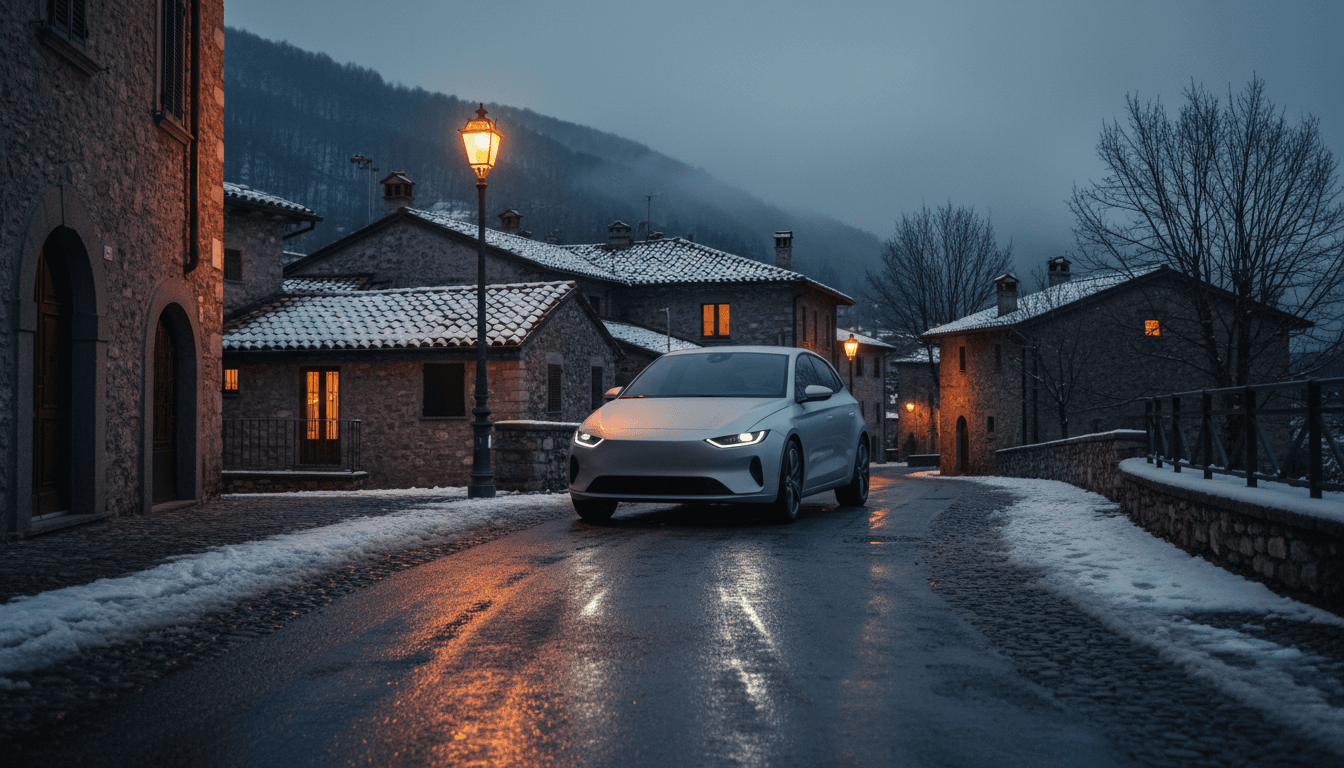
When winter tires become mandatory in Italy for 2026
The clock is already running. On any stretch of road marked with the snow-chain road sign, whether a country road, a state route or a motorway, winter tires (or chains carried on board) become mandatory from 15 November 2026 through 15 April 2027. A grace window opens as early as 15 October 2026 for drivers who want to beat the queue at the tyre shop, and another one runs through 15 May 2027 for switching back to summer tyres without risking a fine for unsuitable equipment [1][2].
It is not a blanket nationwide rule. The obligation applies only to the specific stretches designated by the road authority (ANAS, the motorway operators, the provinces) through a local ordinance, and the only thing that matters on the ground is the vertical sign showing a tyre wrapped in a chain. Drivers who never leave flat urban roads may never see it; anyone heading toward the Apennines, the Alps or a mountain pass from mid-November onward almost certainly will [1].
Regional dates: who goes first
Aosta Valley is the one region with no grace period at all: the obligation there starts on 15 October 2026, a full month ahead of the rest of the country, across the entire regional network [2]. Trentino-Alto Adige, Lombardy and Piedmont often bring mountain stretches forward by a few weeks through provincial ordinances, while central and southern Italy almost always stick to the national 15 November to 15 April window. Before any trip, it is worth checking the ordinance for the specific province being crossed: the national dates are the baseline, not a guarantee of uniform coverage [1][2].
Winter tires or chains: what the law actually allows
The rule gives drivers a choice: fit four winter tyres (or four-season tyres, if properly rated) or carry snow chains compatible with the vehicle, even while running on summer tyres. Chains only count if they are rated for the exact wheel and tyre combination fitted, a detail plenty of drivers discover for the first time at a closed toll booth with snow already falling. For anyone driving daily through hilly or mountain terrain, winter tyres remain the more practical option: no roadside stop to fit chains, and reliable grip even in cold rain or temperatures below 7°C, the point where summer rubber stiffens and braking distances stretch out even on dry asphalt [1][3].
M+S or 3PMSF: the marking that actually matters
Not every tyre stamped M+S (Mud and Snow) on the sidewall is equal. The M+S marking is self-declared by the manufacturer and only signals that the tread pattern and compound are designed with mud and light snow in mind, with no standardized test behind it. The 3PMSF symbol, three mountain peaks with a snowflake, is the only marking that certifies the tyre has passed standardized snow-braking, traction and handling tests. Both markings currently satisfy Italian law, but reports out of the Ministry of Infrastructure suggest a 3PMSF-only requirement could land by 2027, following Germany and Austria. Anyone buying new tyres now would do well to look for the snowflake symbol directly, rather than replace a set again in two seasons [4].
The fines if you are stopped without winter equipment
Drivers caught without suitable tyres or chains on a stretch where the obligation applies face fines from 41 to 168 euros in built-up areas, 84 to 335 euros outside built-up areas, and 80 to 318 euros on motorways. Beyond the fine, police can hold the vehicle until it is brought into compliance, a serious problem if the stop happens far from home or during a weekend ski trip [1][2].
Buying a used vehicle this autumn: what to check on the tyres
Anyone shopping for a used car or scooter right now should add tyres to the inspection checklist, not just bodywork and service history. Three things worth checking before signing anything:
- Tread depth: the legal minimum is 1.6mm, readable off the wear indicators moulded into the grooves, but grip on wet roads and snow drops noticeably below 4mm on summer tyres and 3mm on winter ones. If the listing does not mention it, ask before booking a viewing [5].
- Tyre age, not just wear: the production date is stamped on the sidewall as a four-digit code, the first two digits are the week and the last two are the year. A seven- or eight-year-old tyre can look fine and still have lost rubber elasticity, even with plenty of tread left.
- The right marking: if the seller claims winter tyres are already fitted, check for M+S or, better, the 3PMSF snowflake, not a generic all-season tyre mistaken for one.
A worn or soon-to-be-replaced winter set belongs in the price negotiation: a mid-range set of four tyres for a city car runs roughly 300 to 500 euros fitted, a figure worth raising before the deal closes rather than discovering it in December.
Selling with winter tires on: worth stating in the listing
Anyone selling a car or motorcycle in this end-of-year window has one more selling point worth spelling out: if a winter set is included, recent and correctly marked, say so explicitly, with the remaining tread depth if known. It is the kind of detail that tips a buyer comparing several listings, especially one buying close to mid-November who would otherwise face an immediate extra cost.
The bottom line before mid-November
The real countdown is a matter of weeks. Anyone who regularly drives outside city limits should plan the tyre swap between mid-October and early November, check the sidewall marking (3PMSF if possible), and, if buying or selling a used vehicle in this window, treat tyres as their own line item in the price rather than an afterthought.
Sources
- AutoScout24, Obbligo gomme invernali: quando scatta e quali sanzioni, https://www.autoscout24.it/informare/consigli/norme-della-strada/obbligo-gomme-invernali-quando-scatta-e-quali-sanzioni/
- Automobile360, Pneumatici Invernali Obbligatori in Italia 2026: Normativa Regionale Aggiornata, https://www.automobile360.it/pneumatici-invernali-obbligatori-in-italia-2026-normativa-regionale-aggiornata/
- Ayvens, Cambio gomme invernali 2025/2026: date, tolleranza e multe, https://www.ayvens.com/it-it/blog/conducenti/cambio-gomme-invernali/
- Ayvens, Pneumatici invernali: marcature 3PMSF e M+S spiegate, https://www.ayvens.com/it-it/blog/conducenti/pneumatici-invernali-3pmsf-ms-differenze/
- GommaDiretto, Limite battistrada pneumatici: qual e, https://www.gommadiretto.it/limite-battistrada
Further reading
- Obbligo gomme invernali: quando scatta e quali sanzioni — AutoScout24
- Pneumatici Invernali Obbligatori in Italia 2026: Normativa Regionale Aggiornata — Automobile360
- Cambio gomme invernali 2025/2026: date, tolleranza e multe — Ayvens
- Pneumatici invernali: marcature 3PMSF e M+S spiegate — Ayvens
- Limite battistrada pneumatici: qual e — GommaDiretto
Related articles

Diesel Particulate Filter: Warning Light and Cost
A lit DPF warning light is not a breakdown, it is an alert. Here is what cleaning, regeneration or replacement really costs, what to check before buying a used diesel, and why a removed filter costs far more than it seems to save, as inspection checks get stricter from 2026.
Timing Belt: When to Change It and What It Costs
Real replacement intervals by brand, preventive costs versus a breakage, and what to check before buying or selling a used car.