Timing Belt: When to Change It and What It Costs
Real replacement intervals by brand, preventive costs versus a breakage, and what to check before buying or selling a used car.
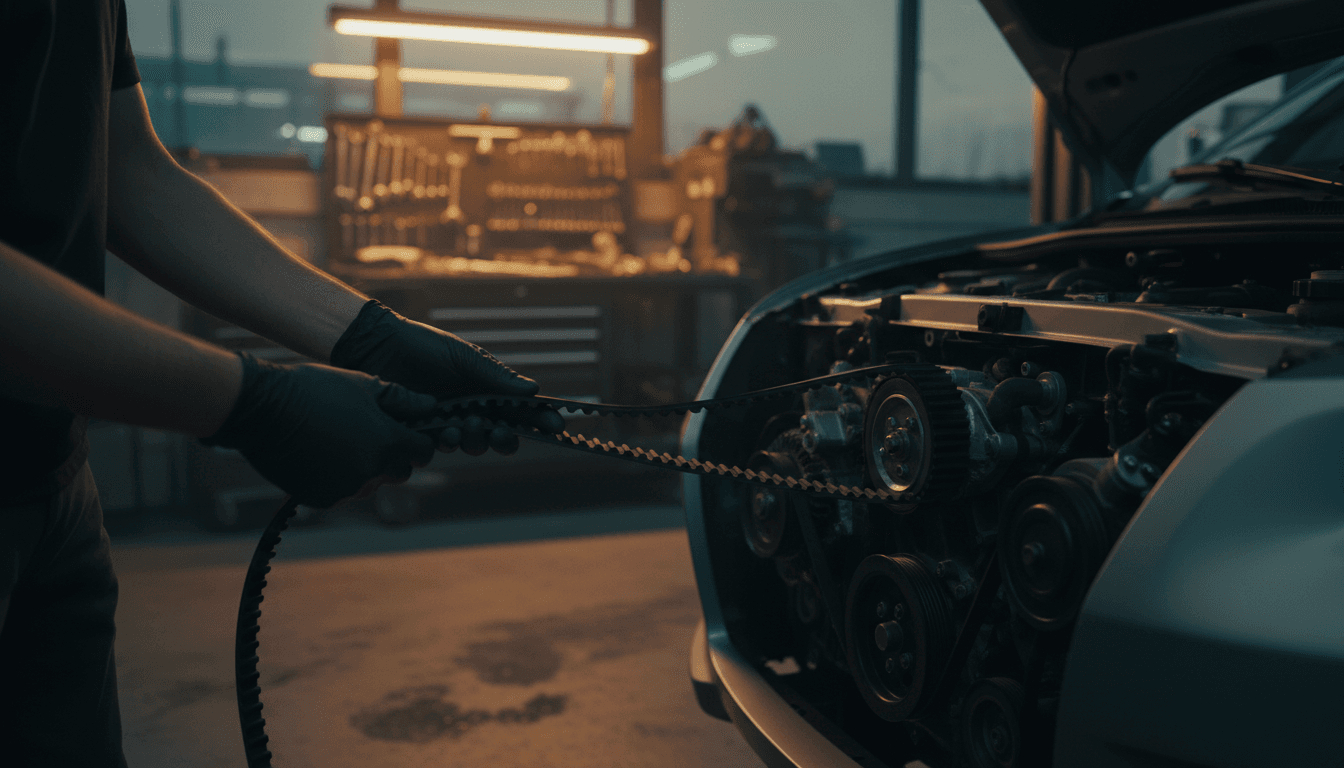
Why the timing belt is the most feared maintenance item on any car
Of every scheduled maintenance job on a car, replacing the timing belt is the one that causes the most anxiety, and for good reason. It is one of the few jobs where missing the deadline does not just mean paying more later: it means risking a rebuilt engine. The belt keeps the crankshaft and camshaft turning in sync, opening and closing the valves at the exact moment the pistons rise and fall [1]. If it snaps while the engine is running, that synchronisation is lost in a fraction of a second, and in interference engines, which make up most of the cars on the road today, the pistons and valves end up colliding.
Belt or chain? The first thing to check
Not every engine uses a rubber belt. Many, especially newer ones, use a metal chain instead, conceptually similar to a bicycle chain [4]. A chain has no scheduled replacement interval: in theory it lasts the life of the engine, provided it runs on quality oil and the oil-change intervals are respected [4]. A belt, by contrast, is reinforced rubber that degrades over time regardless of mileage, and has to be replaced at fixed intervals even when it still looks fine on the outside. The easiest way to know what is under your own bonnet is to check the service book or look up the engine code online. Some manufacturers, notably, are converting engines that historically ran on a belt over to a chain specifically to remove this deadline from the owner's calendar, a telling sign of how much the scheduled swap is seen as a weak point of the whole system [2].
How often it actually needs changing, by brand
There is no single interval that applies to every car: it depends on the manufacturer and the engine fitted. As a general reference, most cars on Italian roads need the belt replaced between 60,000 and 120,000 km, or every 4 to 6 years, whichever comes first [1]. A few concrete examples worth knowing:
- Renault and Dacia: 5 years or 120,000 km on the newer petrol engines, 5 years or 100,000 km on dCi diesels.
- Peugeot and Citroën: 6 years or 100,000 km on the 1.2 PureTech where it still runs a belt, up to 10 years or 180,000 km on the 1.6 HDi.
- Volkswagen, Audi, Skoda: 5 years or 120,000 km on TDI engines, up to 7 years or 210,000 km on the newer TSI units.
- Ford: 8 years or 160,000 km on EcoBoost engines.
On diesel engines, the interval tends to be tighter overall, often 60,000 to 90,000 km every 4 to 5 years, because they run at higher pressures and put more stress on the belt than an equivalent petrol unit [3]. The practical rule stays simple: the manufacturer's own owner's manual has the final word, and when in doubt it pays to replace early rather than risk going past the stated deadline.
What it actually costs at the garage
In Italy, preventive replacement on a compact car or mid-size saloon runs between 300 and 700 euros, parts and labour included [1]. The kit alone, which covers the belt, tensioner, rollers, and usually the water pump too (since it is driven by the same belt and gets swapped at the same time), costs between 120 and 300 euros; labour adds another 200 to 400 euros depending on how accessible the engine is on that particular model. On SUVs, premium saloons, or engines with a more complex timing setup, the total can climb to 800 to 1,200 euros [1][2]. An independent garage typically costs less on average than an official dealership, though the gap narrows whenever the dealer is running a seasonal service promotion.
What happens, and what it costs, if it breaks
This is the real reason not to put the job off. If the belt snaps while the engine is running, in an interference engine the pistons and valves collide within a fraction of a second. The mildest damage, bent valves with nothing else involved, starts at 1,500 to 3,000 euros; if the cylinder head is also affected, that climbs to 3,000 to 5,000 euros; in the worst cases, where the engine has to be rebuilt or replaced outright, the bill easily exceeds 10,000 euros [2]. Set against the 300 to 700 euros of a preventive replacement done on time, the arithmetic is straightforward: putting it off saves nothing, it only raises the odds of a much bigger bill.
The warning signs worth taking seriously
A belt rarely fails without any notice at all. The most common signs are a metallic noise, a repetitive ticking, or a prolonged squeal coming from the front of the engine, often more noticeable on a cold start or under acceleration [5]. Other clues to watch for include difficulty starting, a noticeable loss of power, rising fuel consumption with no other explanation, or dark smoke from the exhaust right after starting up [5]. During a visual check, which usually means removing a plastic cover or two, the things to look for on the belt itself are surface cracks, frayed edges, or visibly worn teeth [5]. If you notice even one of these symptoms, it is not worth waiting for the next scheduled service: book an inspection right away.
If you are buying a used car
Before signing anything, ask the seller for the service book and check, carefully, the date and mileage of the last belt replacement. Mechanics, beyond noting it in the book, often stick a small label inside the engine bay with the date and mileage of the job: look for it, it is a quick way to verify the claim without taking the seller's word alone [3]. If that paperwork is missing or vague, the safer assumption is to treat the car as if the belt has never been changed, and get a quote before offering full asking price. If the car is close to, or already past, the manufacturer's stated deadline, that cost, typically 300 to 700 euros, belongs in the negotiation, not discovered after the sale when there is no room left to renegotiate.
If you are selling: get your paperwork ready
A seller with a freshly replaced belt and the invoice in hand starts the negotiation from a position of strength: it is concrete proof that cuts off a buyer's objections and holds up better against a lowball offer. If the deadline is approaching, it is worth weighing whether to replace it before listing the car. The cost of the job is almost always recovered through a faster sale and a smaller discount than the buyer would otherwise demand, using that very deadline as their main argument for knocking hundreds of euros off the price.
The bottom line
The timing belt is not an avoidable expense: it is a certain cost, only ever postponed. Changing it early, on the manufacturer's own schedule, costs a few hundred euros; putting it off until it breaks can cost ten times as much and wreck an otherwise healthy engine. Anyone buying or selling a used car should treat the date of the last belt change as one of the first documents to check, right alongside mileage and the service book, not as a minor detail to discover only after the fact.
Sources
- AutoScout24, When to change the timing belt and how much it costs, updated 22 January 2026, https://www.autoscout24.it/informare/consigli/componenti-auto/cinghia-di-distribuzione-funzione-manutenzione-e-costi/
- Automobile360, Timing Belt 2026: When to Change It, Warning Signs and Replacement Costs, 17 June 2026, https://www.automobile360.it/cinghia-di-distribuzione-2026-quando-cambiarla-segnali-di-degrado-e-costi-di-sostituzione/
- Mettere In Pratica, How to Check the Timing Belt of a Used Car Before Buying It, 11 October 2024, https://www.mettereinpratica.it/come-controllare-la-cinghia-di-distribuzione-di-unauto-usata-prima-di-comprarla/
- SicurAUTO.it, Is a timing chain better than a timing belt?, 2 March 2026, https://www.sicurauto.it/ricambi-e-accessori/tecnica-e-manutenzione/e-meglio-la-catena-di-distribuzione-o-la-cinghia-di-distribuzione/
- SoloMotori, Timing belt: how to tell if it is faulty or worn, 11 March 2025, https://www.solomotori.it/2025/03/11/cinghia-di-distribuzione-come-capire-se-e-difettosa-o-usurata-questi-sono-i-rumori-a-cui-fare-attenzione/
Further reading
- Quando cambiare la cinghia distribuzione e quanto costa — AutoScout24
- Cinghia di Distribuzione 2026: Quando Cambiarla, Segnali di Degrado e Costi di Sostituzione — Automobile360
- Come Controllare la Cinghia di Distribuzione di un'Auto Usata Prima di Comprarla — Mettere In Pratica
- È meglio la catena di distribuzione o la cinghia di distribuzione? — SicurAUTO.it
- Cinghia di distribuzione: come capire se è difettosa o usurata — SoloMotori
Related articles

Winter Tires in Italy 2026: Dates and Fines
Italy's winter tyre law kicks in on 15 November 2026: dates, fines, the real difference between M+S and 3PMSF, and what to check on the tyres before buying or selling a used vehicle this season.
Diesel Particulate Filter: Warning Light and Cost
A lit DPF warning light is not a breakdown, it is an alert. Here is what cleaning, regeneration or replacement really costs, what to check before buying a used diesel, and why a removed filter costs far more than it seems to save, as inspection checks get stricter from 2026.