Timing belt: when to replace it and what it costs
How many km and years between timing belt changes, what the job costs, how to check the history on a used car and how to use it to negotiate the price.
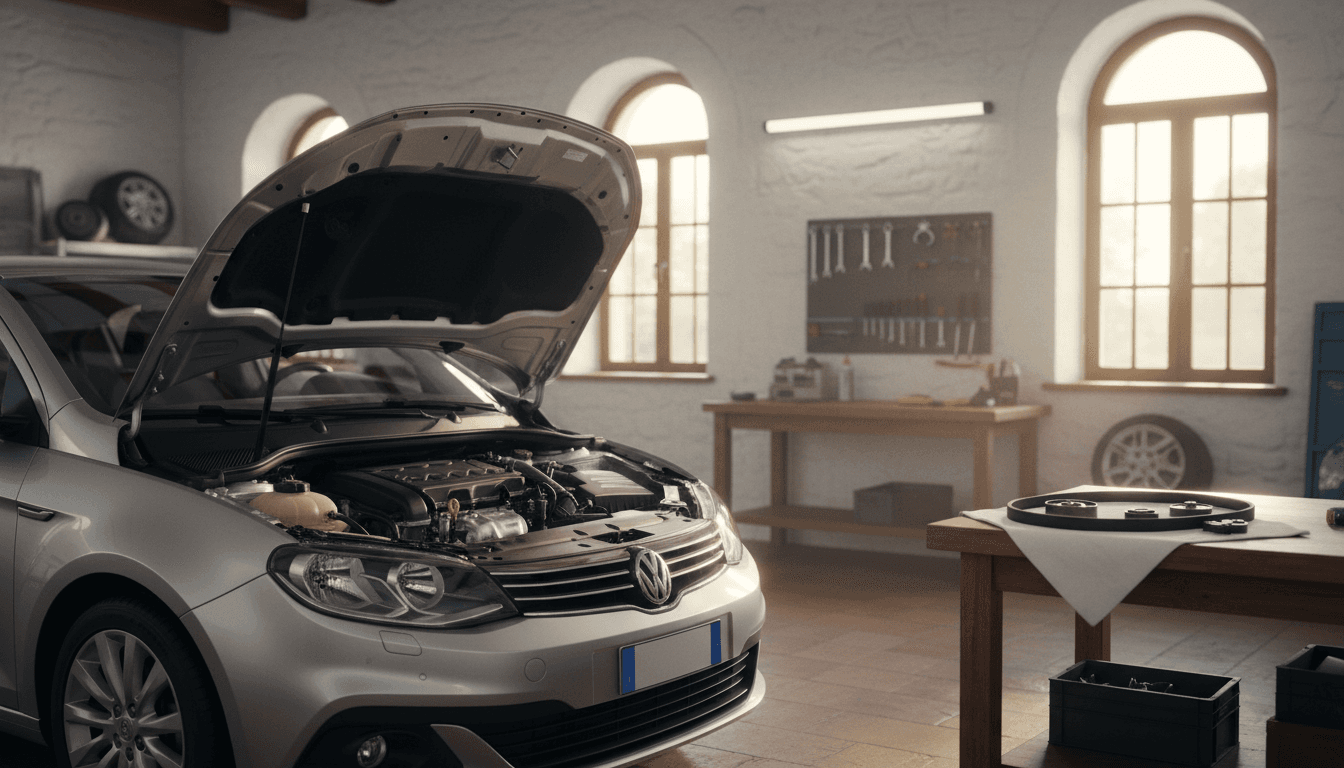
If you are buying or selling a used car in Italy, the timing belt, called cinghia di distribuzione in Italian, is one of the items that weighs most on the real price. Ignoring it can cost a few thousand euros; replacing it on time costs about as much as a good service. This guide covers when it should be changed, what it costs, how to tell whether it has already been done, and how to use that in a negotiation.
What the timing belt does
The timing system synchronises the crankshaft and the camshaft, opening and closing the valves at the right moment relative to the pistons. If that sync is lost, or the belt snaps, valves and pistons can collide. On so-called interference engines the result is serious: bent valves, a cylinder head to rebuild, and in some cases a replacement engine.
On some engines the same belt also drives the water pump. When the work is done, it usually makes sense to consider replacing both together, since most of the labour overlaps.
How often: kilometres and years
There is no single number for every car. Specialist sources generally give a window of 60,000 to 120,000 km or every 4 to 6 years, depending on the engine, and stress that the binding reference is the manufacturer's service booklet. Some modern engines go further, others ask for shorter intervals.
A concrete example from the Italian motoring press: for the Fiat 1.2 8V the maker specifies a maximum of 120,000 km or 6 years, but advises bringing it forward to 60,000 km or 4 years for dusty roads, city driving or harsh climates.
Mileage habits matter too. Drivers covering more than 25,000 km a year should lean towards about 70,000 km, while low-mileage owners must not forget the time criterion: rubber ages even when the car sits still. That is why a low-mileage but old used car can have an expired belt.
What it costs
For an average car, sources point to roughly 600 euros including labour and VAT. Split up, the part alone runs from about 40 to 150 euros, while labour can range from 400 to 1,000 euros depending on how complex the engine is. Some transverse engines or diesels in tight bays can take many hours.
The comparison with the risk is stark: if the belt fails and damages the valves, the repair can reach roughly four times the preventive replacement, around 2,400 euros, and far more in worse cases.
Always ask for a quote that itemises the kit: belt, tensioners, idlers and, where the belt drives it, the water pump. Compare at least two or three garages.
Chain or belt: what matters when you buy
A chain is metal, lubricated by engine oil, and in theory lasts as long as the engine, although very high mileage can still call for work. When it does need replacing, though, the job is longer and more expensive. In short: a belt costs less each time but must be planned, a chain lasts longer but costs more if it fails.
There is also a middle road, the wet belt, used for example on the 1.2 PureTech: it runs in oil like a chain but is rubber and has to be replaced on schedule, often earlier than conventional belts. Before buying, check exactly which system the specific engine uses, because the same model can differ by version and year.
Broadly, groups such as Volkswagen, Renault and Stellantis often use belts, while BMW, Mercedes and many Japanese brands prefer chains. That is a tendency, not a rule: check the individual vehicle.
How to tell whether it has been changed
Before making an offer on a used car, follow these steps:
- Ask for the service invoices showing the timing item, with date and mileage.
- Look for a sticker or label in the engine bay or on the timing cover: many garages note the date and km of the job.
- Compare the history with the booklet limits, in both km and years.
- If there is no proof, treat the belt as due now and factor the cost into the deal.
- Have a garage check it before purchase, especially if the car is over 100,000 km or six years old.
Using it in the negotiation
An expired belt, or one with no paper trail, justifies a price reduction equal to the cost of the job, typically 500 to 900 euros depending on the model. If the seller proves a recent replacement with an invoice, the car deserves a slightly higher price: you avoid an imminent expense. If you are selling, keep invoices and records in order; it is one of the details that most reassures a private buyer.
The practical takeaway
Open the booklet, read the interval for that engine and compare it with the car's mileage and age. If the deadline is close or already passed, schedule a full replacement with the kit and, if needed, the water pump. When buying, insist on proof of the work or deduct its cost from the price. It is a few hundred euros today against a few thousand tomorrow.
Sources and further reading
The guidance on intervals and costs is summarised from Motor1 Italia, Sicurauto, AutoScout24, Autoblog and Telepass Moveo, listed below. For your own engine, the manufacturer's booklet remains the final word [1][2][3][4].
Further reading
- Cinghia distribuzione, cos'è e quando sostituirla — Motor1 Italia
- Cinghia di distribuzione: quando si cambia? — Sicurauto
- Quando cambiare la cinghia distribuzione e quanto costa — AutoScout24
- Cinghia di distribuzione, quando è il momento di sostituirla — Autoblog
- Cinghia di distribuzione: quando cambiarla — Telepass Moveo
Related articles

Italy car inspection 2026: cost, deadline, fines
When the Italian revisione is due, what it really costs in 2026 (79.02 euros), what is checked, the possible results and the fines for missing it: a practical guide for used-car buyers and sellers.

Winter Tires in Italy 2026: Dates and Fines
Italy's winter tyre law kicks in on 15 November 2026: dates, fines, the real difference between M+S and 3PMSF, and what to check on the tyres before buying or selling a used vehicle this season.