SUVs: the real pros, cons and who they suit
Space and visibility versus fuel, taxes and bulk: the real pros and cons of an SUV and how to tell whether it fits your life, with the Italian running costs to plan for.
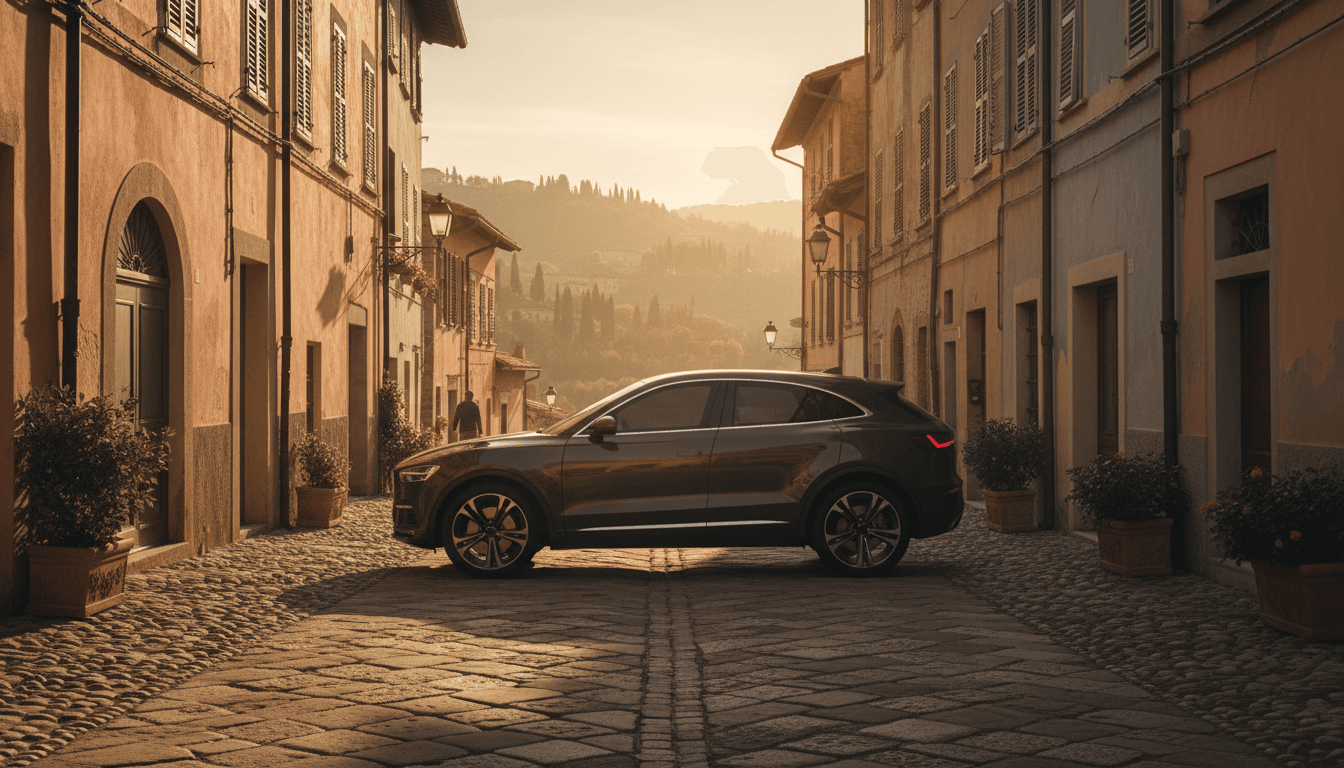
Why SUVs took over Italy's roads
Over the past few years the SUV has gone from niche to default: today it accounts for roughly half of all new cars registered in Italy, and the used market is just as crowded. A raised driving position, a rugged look, a sense of space — the appeal is easy to understand. But an SUV is not the right car for everyone, and the gap between a smart purchase and a regret comes down to weighing the real pros and cons against how you actually drive. Let us go through them honestly.
The genuine advantages
The first strength is the driving position. Sitting 15-20 cm higher than in a saloon improves your view of traffic and makes getting in and out easier — a detail that matters a lot for anyone with back or hip trouble, for older drivers, and for parents fitting a child seat every day.
Next comes space and versatility. Within the same class, an SUV usually offers a bigger boot and a higher, squarer loading lip that suits pushchairs, bags, tools or a dog crate. The extra ground clearance (often 18-21 cm) helps on gravel tracks, steep garage ramps, speed bumps and snow, while all-wheel-drive versions add confidence in the mountains and in winter.
There is also perception: many drivers simply feel safer behind a tall, imposing body. Finally, residual value — the most sought-after SUVs tend to depreciate less than equivalent saloons and people-movers, which pays off at resale.
The costs you feel in your wallet
This is where the trade-offs begin. The most obvious is fuel. Extra weight (often 100-300 kg more) and a larger frontal area make an SUV burn 10 to 20% more than a low-bodied car in the same class. Over 15,000 km a year, that difference at the pump adds up fast.
Weight and power also drive up taxes. The bollo (annual road tax) is calculated on kW and Euro emission class, so bigger engines mean a bigger bill. Very powerful versions can trigger the superbollo, the state surcharge of 20 euro for every kW above 185 kW (about 252 hp), as the ACI explains; it tapers down after 5, 10 and 15 years from the build date. Most mainstream SUVs stay under the threshold, but sporty or high-performance hybrid variants do not.
Budget too for insurance (RC auto), often pricier because of the vehicle's value and higher repair costs, and for tyres: 17-to-20-inch wheels and wide rubber cost more, and a full set can weigh heavily on the running budget over the car's life. The revisione (the periodic roadworthiness test), by contrast, costs the same for every car — around 79 euro at private centres, every two years after the first four — but still belongs in the total.
Handling, city driving and parking
An SUV is taller and heavier, and physics gives no discounts: a higher centre of gravity and more mass mean body roll in bends, slightly longer braking distances and less agility than a saloon. On the motorway it is no problem; on a mountain pass it is.
In town, sheer size is what bites. Many compact SUVs are over 1.80 m wide and 4.3-4.6 m long, and large models go further; in narrow bays, herringbone car parks and historic centres with ZTL (limited-traffic zones) and tight streets, manoeuvring becomes an exercise in patience. Parking sensors and a 360-degree camera help, but the car is still big. Tyre wear, thanks to the weight, also tends to run higher.
Safety: myth versus reality
Sitting up high feels protective, but that is not the whole story. Real safety depends on the specific model and its Euro NCAP scores, not on the body shape: there are superminis and saloons with excellent ratings and mediocre SUVs, and the other way round.
The high centre of gravity makes a rollover statistically a little more likely, although electronic stability control has cut that risk sharply. Consider the impact on others, too: a tall, heavy front is more aggressive toward pedestrians and small cars in a crash, and thick pillars can create blind spots. The ADAS features now fitted as standard (autonomous braking, lane keeping, blind-spot warning) offset a lot — but the rule holds: choose the model, not the myth.
Who really benefits — and who does not
An SUV genuinely suits people with real needs for space and height: families with young children and car seats, anyone who loads the boot often, owners of a medium or large dog, those living in the countryside, the hills or areas with snow and dirt roads, and drivers who cover long, fully loaded motorway stretches and value comfort and a commanding view. Anyone with limited mobility gains real benefit from the tall seat.
It suits far less those who drive almost only in the city with tight parking and ZTLs, who cover few kilometres a year, who watch their running budget (fuel, bollo, tyres, insurance) or who mainly want driving pleasure. Here it is worth looking at often more rational alternatives: an estate offers the same boot while drinking less, a compact people-mover gives more room on board, a small crossover or a low saloon costs less to run and parks anywhere. Your patente (driving licence) makes no difference — a category B covers them all.
How to choose without regret
Before you sign, do some honest maths. Start from your real use: how many kilometres, where, with how many people and what load. Then think in terms of total running cost, not just the sticker price: add up realistic fuel (look at measured on-road consumption, not just the WLTP figure), bollo, insurance, tyres and revisione. Check the kW on the logbook to see whether the model brushes against the superbollo. If you buy used, factor in the passaggio di proprietà (ownership transfer), whose IPT tax rises with kW: a powerful SUV costs more just to register in your name.
Verify the exact model's Euro NCAP scores, try the car in a real car park to see whether the footprint suits you, and if state incentives interest you, remember they are often tied to ISEE income thresholds and emission limits. Compare the used market calmly — including on VendiVoce — putting an SUV side by side with an equivalent estate or crossover: sometimes the smartest choice is not the tallest one. In short, an SUV is an excellent tool for those who truly need it, and an expensive luxury for those who buy it only for fashion.
Further reading
- Bollo auto, superbollo e costi di gestione del veicolo — Automobile Club d'Italia (ACI)
- Prove su strada, consumi reali e recensioni dei SUV — Quattroruote
- Test e consumi reali di SUV e crossover — alVolante
- Valutazioni di sicurezza dei veicoli — Euro NCAP
- Revisione periodica dei veicoli: obblighi e tariffe — Ministero delle Infrastrutture e dei Trasporti (MIT)
Related articles
Opel Frontera Manual 2026: New or Go Used?
Opel just launched the Frontera Start, a 100-hp manual entry point priced from 17,900 euros on promotion. Here is what the fine print hides, and when a used compact SUV still wins.
Best Cheap Used City Cars in Italy 2026
With no new city car left under 10,000 euros in Italy, used is the only route to a cheap runabout. Here is what a used Panda, 500, Aygo X, Picanto or i10 really costs, what insurance and road tax add on top, and what to check before you sign.