Motorcycle licences A1, A2 and A: which one you need
AM, A1, A2 or A: in Italy the licence you need for a bike or scooter depends on your age, engine size and power. Here is what each one lets you ride, the kW limits, and how to move up the ladder.
Motorcycle licences in Italy, at a glance
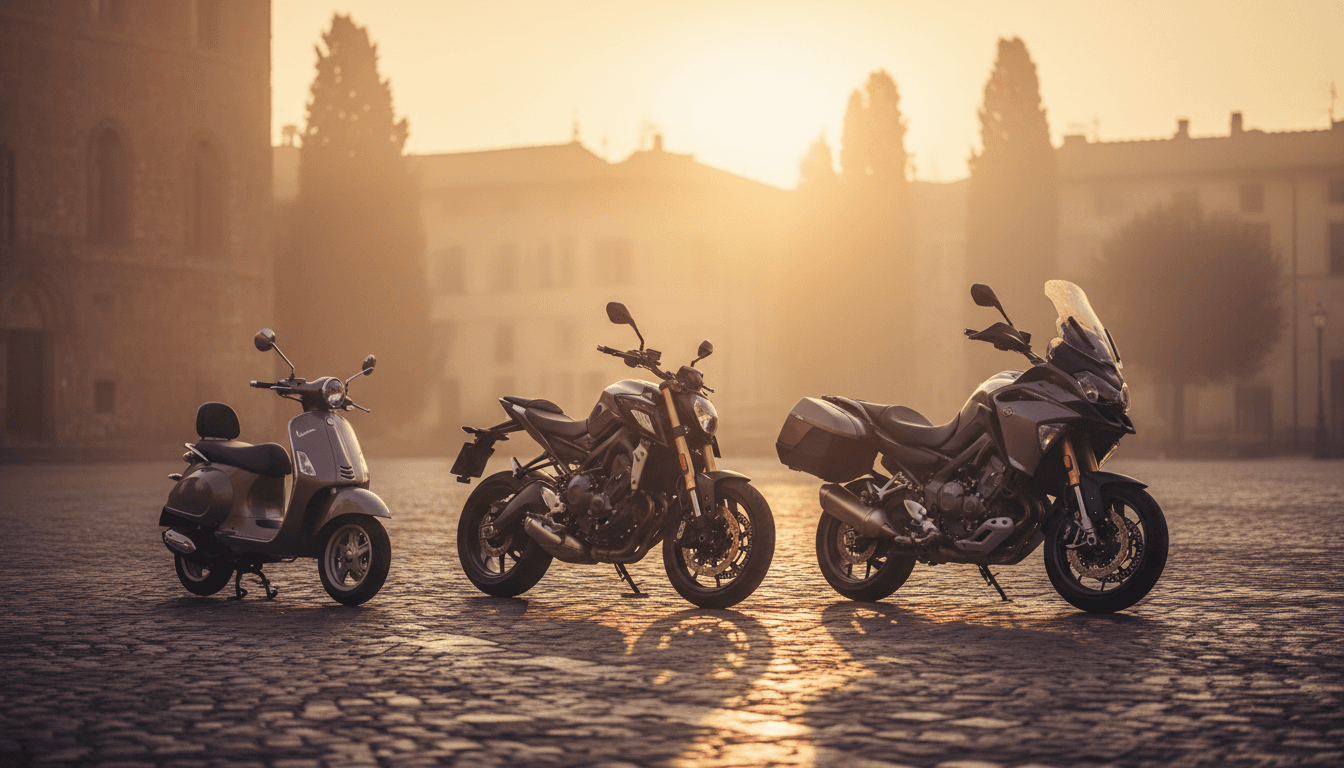
Italy does not have a single licence for two wheels. Instead there is a four-step ladder — AM, A1, A2 and A — designed to grow with your age and experience. Each rung unlocks larger engines and more power, with precise limits on kilowatts and on the power-to-weight ratio. Working out which licence you need is the first decision to make, before you even start shortlisting a scooter or a bike: the requirements for a city 50cc and a big naked are worlds apart. Here is what each category lets you ride, the minimum age to sit the exam, and how to climb from one level to the next without starting over.
Patente AM: your first vehicle at 14
The AM licence is the gateway to two wheels and can be earned as early as 14. It covers mopeds (ciclomotori): two-wheelers with an engine up to 50cc for petrol models, no more than 4 kW of power and a design speed capped at 45 km/h. AM also covers light three-wheelers and light quadricycles — the 45 km/h microcars that give many teenagers their first taste of independent travel.
Getting it means passing a theory test (a road-code quiz) and a practical exam, both off the road and on it. This is the document you need for the classic city 50cc scooter: light, cheap to run and ideal for short trips. Keep the limits in mind, though: a passenger is allowed only if the rider is of legal age and the moped is type-approved for two, and mopeds are barred from main extra-urban roads and motorways.
Patente A1: 125cc from 16
From 16 you can sit the A1, and it is a meaningful step up. It covers motorcycles up to 125cc with a maximum of 11 kW (around 15 hp) and a power-to-weight ratio no higher than 0.1 kW/kg. It also includes three-wheelers up to 15 kW and, of course, everything in the AM category.
This is the licence for the 125 scooter, the everyday workhorse of Italian cities for commuters and students: it can use ring roads, carry a passenger and handle out-of-town routes. One practical detail that often gets missed: anyone holding a patente B (car licence) may ride a 125 up to 11 kW in Italy — but only on national soil, never abroad. So if you already drive a car, the 125 is effectively within reach with no extra exam.
Patente A2: mid-size bikes from 18
At 18 the A2 opens up, aimed at mid-power motorcycles. Here the limit is no longer engine size but power: a maximum of 35 kW (about 47 hp), with a power-to-weight ratio no higher than 0.2 kW/kg. There is one extra condition: the bike must not be derived from a version producing more than double that power, so it cannot simply be a restricted model of over 70 kW.
The A2 lets you ride a large slice of today's market, often sold in a factory-restricted 35 kW version: naked bikes, mid-capacity sports models, road-going enduros and the more powerful maxi-scooters. For many younger riders it is the sweet spot between performance and age requirements.
Patente A: no power limit
The A licence is the unrestricted one: it covers any motorcycle, from litre-class superbikes to large maxi-scooters, plus three-wheelers above 15 kW (for those the minimum age is 21). For motorcycles, direct access — earning it from scratch — is only possible from the age of 24.
There is a shortcut, though. Anyone who has held the A2 for at least two years can move up to the A at just 20, sitting the practical exam alone. That is why many riders take the A2 at 18 and then progress, reaching the full licence several years earlier than through direct access.
Climbing the ladder: how progression works
The system is built as a staircase, and that saves both time and money. Once you have held the A1 for two years, you can move to the A2 with only the practical exam — no need to repeat the theory. In the same way, two years with an A2 gets you to the A on the practical test alone.
So the typical path runs A1 at 16, A2 at 18, A at 20. Each step calls for a new practical exam but not a fresh theory quiz, as long as you meet the two-year seniority. Direct access remains an option too: A1 at 16, A2 at 18, A at 24. Once you pass the theory you receive the foglio rosa, the provisional permit valid for twelve months and good for two attempts at the practical.
Scooter or bike? Which licence you really need
The most common confusion is exactly here, because the licence depends not on the shape of the vehicle but on engine size and power. A 50cc scooter needs the AM (14). A 125 scooter or motorcycle needs the A1 (16), or the car licence B for riders who stay inside Italy. A 300 or 400cc maxi-scooter falls under the A2 (18) as long as it stays within 35 kW. The most powerful maxi-scooters, 500cc and up with more than 35 kW, need the full A licence instead.
The same logic applies to motorcycles: what counts is the number of kilowatts, not the styling. Before falling for a particular model — perhaps while browsing used listings on VendiVoce — it is worth checking the declared power on the vehicle documents and matching it against the licence you actually hold.
The practical takeaway
In short: AM at 14 for 50cc, A1 at 16 for 125cc, A2 at 18 for bikes up to 35 kW, and A at 24 (or 20 stepping up from the A2) with no limits. The power-to-weight ratio — 0.1 kW/kg for the A1 and 0.2 kW/kg for the A2 — matters as much as the raw kilowatts, so always check it on the certificate of conformity.
Beyond the licence, putting a bike on the road also means budgeting for running costs: compulsory RC insurance, the bollo (road tax) where it applies, and the revisione (roadworthiness test), first due four years after registration and every two years after that. Pick the right category first and the machine second — not the other way round — and you will never be left with a bike you are not yet allowed to ride.
Further reading
- Patenti di guida: categorie, requisiti ed età minime — Ministero delle Infrastrutture e dei Trasporti (MIT)
- Automobile Club d'Italia: guide e pratiche su patenti e veicoli — ACI
- Patenti moto A1, A2 e A: le categorie e cosa permettono — Quattroruote
- Patenti per moto e scooter: limiti di potenza e cilindrata — Motociclismo
- Patente A, A1, A2 e AM: requisiti, età e progressione — Motor1 Italia
Related articles
BMW Electric Scooters: CE 04 vs CE 02 Guide 2026
CE 04 vs CE 02 compared: 2026 prices, licenses, range, and how the trade-in Ecobonus can make a new one almost as cheap as a used one.
Scooter 125 Ownership Transfer: 2026 Costs
Bought or sold a used 125cc scooter? Here is what the 2026 ownership transfer really costs, which documents you need under the Documento Unico, and what happens if you miss the 60-day deadline.