Italy's Speed-Fine Overhaul: What the Draft Highway Code Reform Means for Drivers in 2026
Italy's transport ministry has opened consultation on a draft that would replace 82 fine brackets with a proportional per-km/h calculation. Here is what is changing, the timeline, and what it means for drivers and used-car buyers.
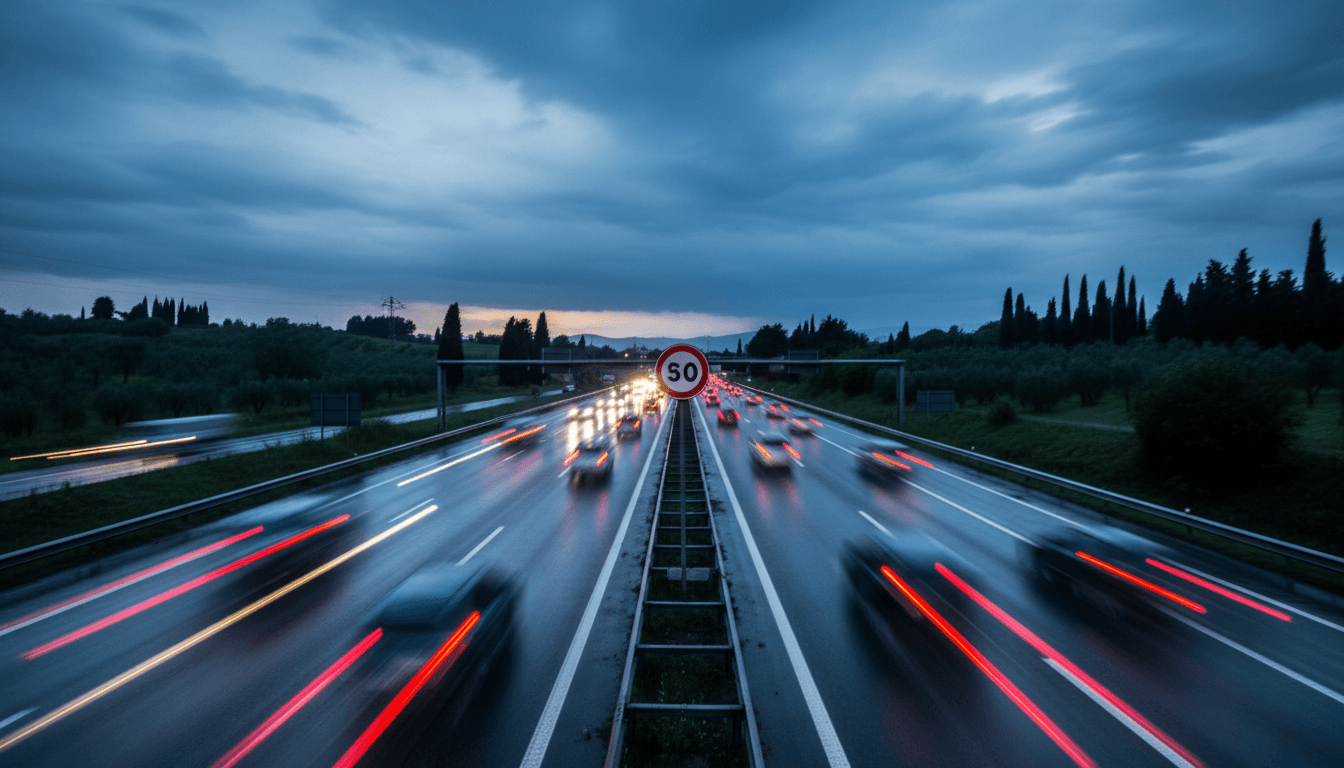
What is changing about speeding fines
In early August 2026 Italy's Ministry of Infrastructure and Transport sent a draft overhaul of the Highway Code (Codice della Strada) to more than a hundred trade and consumer associations, opening a consultation window that closes on September 13, 2026 [1][4]. A final text is expected by October 14, 2026, before it heads to Parliament [5]. Nothing has changed yet, so today's rules still apply, but the most debated chapter of the draft is exactly the one that touches every driver directly: how speeding fines get calculated, and how much they cost.
The system as it stands today
Fine amounts for 2026 are the same ones set at the end of 2024, frozen for a third straight year after a decree blocked the usual inflation-linked adjustment [2]. The current structure runs on four brackets: up to 10 km/h over the limit costs 42 to 173 euros, with no points lost and no suspension; 10 to 40 km/h over jumps to 173-694 euros with 3 points deducted; 40 to 60 km/h over runs 543 to 2,170 euros with a one-to-three-month license suspension; and anything beyond 60 km/h over carries the same fine range plus 6 points lost and the same suspension window [6]. Newly licensed drivers face a flat 161 to 647 euros and a two-to-eight-month suspension regardless of which bracket they land in [6]. Speed-camera tolerance stays at 5 km/h for readings up to 100 km/h, and 5 percent above that [2].
How the proposed proportional calculation would work
The ministry's draft wants to replace the bracket system, which it considers rigid and disproportionate, with a linear calculation tied directly to how many km/h a driver is over the limit: roughly 10 euros per km/h on motorways, and 5 to 10 euros per km/h on urban roads depending on how severe the violation is judged to be [1][3]. The number of penalty tiers would shrink from 82 down to about twenty, with the stated goal of making fines easier to understand and more closely tied to the actual risk created by the excess speed [3].
A concrete example
Under the proposed scheme, a driver clocked at 140 km/h on a motorway with a 130 km/h limit, ten km/h over, would pay roughly 100 euros; someone caught at 170 km/h on the same stretch, forty km/h over, would face around 400 euros [3]. These figures are still indicative, since the draft is under consultation and final amounts could shift before approval, but they show the logic shift clearly: the fine now rises continuously with speed instead of staying flat inside a wide bracket until the next threshold is crossed.
License suspension thresholds would also move
Suspension thresholds are set to be rewritten too: the license would be pulled once a driver is more than 20 km/h over the limit on a motorway, or more than 40 km/h over in a built-up area, both lower than today's thresholds, which only kick in from 40 km/h over regardless of road type [1]. For now, the repeat-offense rules introduced in December 2024 stay in place: a second suspension only applies if the same urban zone, the same speed bracket, and a maximum one-year gap between the two violations all line up [2].
The rest of the package
The speed-fine overhaul is traveling alongside other changes in the same draft: lowering the minimum age for a car license (category B) to 17, with supervised driving until adulthood; new rules on overtaking on the right on motorways; immediate vehicle seizure for driving without insurance; and updated rules for electric bicycles [4][5]. It is a wide-ranging package, which is why the ministry opened a formal consultation with consumer groups, automobile clubs and professional associations before locking in a final text.
An uncertified speed camera is not enough
One practical detail worth knowing whether your car is new or used: Italy's Supreme Court, in ruling 12924/2025, confirmed that a speed camera that has only been approved but not formally certified (omologato) cannot produce a valid citation [2]. Before paying a speeding fine, especially a large one, it is worth checking the certification status of the device that recorded it, since that gap is one of the strongest grounds for a successful appeal against a fixed camera.
What it means if you drive, or are buying a used car
For anyone shopping for a used car, particularly a step up in performance from their current one, the reform is a practical reminder: with a proportional calculation, every extra km/h above the limit turns into cost immediately, without the threshold effect that today makes it relatively harmless to sit just under the top of a wide bracket. Buyers moving into a more powerful car should also check with their insurer how a points history could affect premiums, since insurers already factor licence-point deductions into risk pricing. The same caution applies to newly licensed drivers, who often buy a used car as their first vehicle and remain subject to the toughest penalties no matter which speed bracket they fall into.
What to watch in the coming weeks
The decisive window runs between now and September 13, 2026, the deadline for associations and industry bodies to submit feedback and up to five targeted amendment proposals [5]. The text that reaches the Council of Ministers by October 14 could therefore differ, possibly substantially, from the draft that circulated in August. In the meantime, the rules in force are still the 2026 ones: anyone driving, buying or selling a used car in the coming weeks needs to plan around today's fines, not the ones proposed for next year.
Sources
- Quattroruote, Nuovo Codice della strada: tutte le novita su multe, patente a 17 anni, bici e sicurezza, https://www.quattroruote.it/news/burocrazia/2026/08/07/nuovo_codice_della_strada.html, August 7, 2026
- Quattroruote, Nuovo codice della strada: la guida sulle multe per eccesso di velocita, https://www.quattroruote.it/news/burocrazia/2026/08/10/limiti_velocita_multe_nuovo_codice_strada.html, August 10, 2026
- Motor1 Italia, Come cambiano le multe per i limiti di velocita nel nuovo codice della strada, https://it.motor1.com/news/804989/nuovo-codice-strada-2026-limiti-velocita-multe/, August 10, 2026
- Il Fatto Quotidiano, Codice della strada: patente B a 17 anni e sorpasso a destra, le proposte di Salvini, https://www.ilfattoquotidiano.it/2026/08/08/codice-strada-salvini-patente-17anni-riforma-sorpasso-notizie/8474251/, August 8, 2026
- alVolante.it, Nuovo codice della strada: dalla patente a 17 anni alle multe proporzionali, ecco la bozza, https://www.alvolante.it/news/nuovo-codice-della-strada-2026-bozza-416353, August 8, 2026
- Autosupermarket, Multa eccesso velocita 2026: importi, punti e tolleranza, https://autosupermarket.it/magazine/normative-auto/multa-eccesso-velocita-importi-punti-patente, January 10, 2026
Further reading
- Nuovo Codice della strada: tutte le novita su multe, patente a 17 anni, bici e sicurezza — Quattroruote
- Nuovo codice della strada: la guida sulle multe per eccesso di velocita — Quattroruote
- Come cambiano le multe per i limiti di velocita nel nuovo codice della strada — Motor1 Italia
- Codice della strada: patente B a 17 anni e sorpasso a destra, le proposte di Salvini — Il Fatto Quotidiano
- Nuovo codice della strada: dalla patente a 17 anni alle multe proporzionali, ecco la bozza — alVolante.it
- Multa eccesso velocita 2026: importi, punti e tolleranza — Autosupermarket
Related articles
Italy Home EV Charger Bonus 2026: Apply Now
From today, 22 September 2026, Italian residents and condominiums can apply for a grant covering 80% of the cost of installing a home EV charger, up to 1,500 or 8,000 euros. Here is how it works, and why it matters even if the car you're buying is used.
Electric car tax in Italy 2026: what you pay by region
Five years of national exemption, then it is down to the region: from zero euros in Turin to hundreds elsewhere for the identical used EV. Here is how the 2026 electric car tax really varies by region.