Black-Flag Traffic and 40C Heat: The Checks a Used Car Needs Before the August Getaway
The first weekend of August 2026 brings black-flag traffic and an African heat wave pushing past 40C. On an older car, extreme heat hits the battery, tyres and air conditioning first: here is what to check, with the numbers that matter.
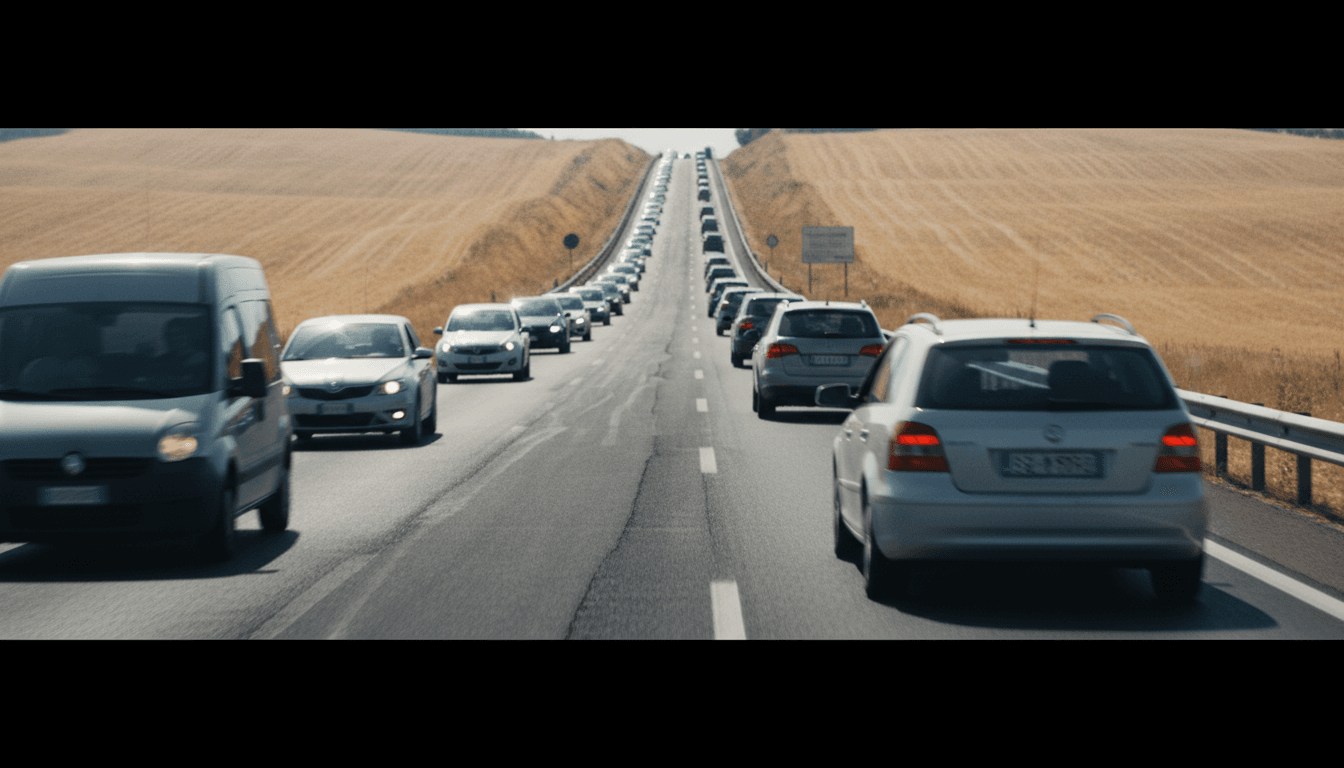
The year's worst weekend, with the thermometer at 40
The first weekend of August is traditionally the most demanding moment of the year on Italian roads, and 2026 is no exception: traffic forecasts flag black and red conditions across the motorway network on Saturday 1 and Sunday 2 August, with the getaway peak concentrated between the first and second week of the month [1]. Adding to the challenge, a fresh African heat wave is pushing temperatures to 40C and beyond across much of the country [2].
That combination matters more than it might seem. Long queues with the engine running on scorching asphalt are precisely the conditions where already-tired components on an older car present the bill. Half an hour of targeted checks, focused on what extreme heat attacks first, is time well spent.
The battery: heat kills it faster than cold
There is a widespread misconception worth clearing up straight away. Almost everyone associates battery trouble with winter, but the real enemy is heat: high temperatures accelerate evaporation of the electrolyte and corrosion of the internal plates [3]. The failure shows up on the first cold morning, but the damage accumulated in August.
On a used car with a battery four or five years old, this is the check with the best ratio of time spent to trouble avoided. A load test at a workshop costs very little and tells you within minutes whether the battery will survive the trip. Check the terminals too: whitish oxidation on the posts is a classic sign of a neglected electrical system.
Tyres: always read the pressure cold
Heat introduces a measurement error here that leads plenty of drivers to travel on incorrectly inflated tyres. As temperature rises, the air inside the tyre expands and pressure climbs. Check after a stretch of sun-baked motorway and the reading is artificially high, so you risk deflating a tyre that was actually correct. The rule is to measure cold, meaning before covering more than a couple of kilometres, against the figures given in the vehicle handbook [3].
On tread depth, the legal minimum in Italy is 1.6 millimetres, but for summer driving on very hot asphalt with a fully loaded car, staying above 3 millimetres is the sensible threshold [3]. Check the sidewalls as well: cracking and bulges on old tyres are a serious risk at speed in high temperatures, no matter how much tread is left.
Air conditioning: not comfort, safety
On a six-hour crawl at 40C, air conditioning that fails to cool stops being an annoyance and becomes a driver-fatigue factor. On used cars the typical issue is gradual refrigerant loss, which shows up as cooling that gets progressively more lukewarm season after season.
Two quick checks: run the system at maximum while stationary and confirm the air actually turns cold within a couple of minutes, and consider replacing the cabin filter if the air smells stale. A saturated filter cuts airflow and noticeably worsens performance in extreme conditions.
Fluids, brakes and wipers
The rest of the list, all cited as essential pre-departure checks [4]:
- Engine oil level and condition. Long distances at high temperatures are the worst possible moment to discover you are below minimum.
- Coolant. This is the check most directly tied to the risk of stopping in traffic with the engine overheating.
- Brakes. Downhill queues and the extra weight of luggage increase the load: pads near the end of their life should be dealt with beforehand, not en route.
- Wipers. Heat and UV degrade the rubber blades: if they smear or squeal, replace them before leaving [3]. A sudden summer storm on a busy motorway is the wrong moment to find out.
- Lights and indicators. A trivial check almost nobody does, and one that counts in night-time traffic.
Loading: the most underrated mistake
A car heading off on holiday is often close to its maximum load, and that changes how the vehicle behaves. Luggage should be distributed with the weight low and as central as possible, avoiding overloading the tailgate or the roof [1]. With the car fully loaded, many manufacturers specify a higher tyre pressure than normal in the handbook: this is one of the few cases where inflating further is correct, and it is written explicitly in the onboard documentation.
Add the common sense that applies to the journey itself: set off rested, avoid heavy meals and alcohol, and stop regularly [1]. Sitting in traffic at 40C, concentration drops far faster than most drivers expect.
The bottom line
You do not need a full service the night before departure, you need a targeted check on what extreme heat genuinely stresses. Battery, tyre pressure measured cold, air conditioning and coolant cover the large majority of summer-getaway breakdowns, and all of them can be verified quickly. On a used car, where the full maintenance history is not always known, that half hour is the highest-return investment of the entire summer. A black-flag weekend is demanding enough without adding an unplanned stop on the hard shoulder.
Further reading
- Missionline, August 2026 getaway: advice for driving in heat and traffic, 2026
- Motor1.it, Summer 2026 traffic forecast: 1-2 August flag ratings, July 2026
- Motorionline, Summer 2026 car advice: 10 things to check before leaving on holiday, 2026
- Quotidiano Motori, Summer getaway 2026, car safety starts at the workshop, 2026
- Motor1.it, Summer getaway 2026: traffic forecasts, flag days and advice, 2026
Further reading
- Esodo agosto 2026: consigli per viaggiare in auto con caldo e traffico — Missionline
- Previsioni traffico estate 2026: 1-2 agosto, bollini — Motor1.it
- Consigli auto estate 2026: 10 cose da controllare prima di partire per le vacanze — Motorionline
- Esodo estivo 2026, la sicurezza auto parte dall'officina — Quotidiano Motori
- Esodo estivo 2026: previsioni del traffico, bollini e consigli — Motor1.it
Related articles
Winter Tires in Italy 2026: Dates and Fines
Italy's winter tyre law kicks in on 15 November 2026: dates, fines, the real difference between M+S and 3PMSF, and what to check on the tyres before buying or selling a used vehicle this season.
Diesel Particulate Filter: Warning Light and Cost
A lit DPF warning light is not a breakdown, it is an alert. Here is what cleaning, regeneration or replacement really costs, what to check before buying a used diesel, and why a removed filter costs far more than it seems to save, as inspection checks get stricter from 2026.