The electric moped you can ride without a licence does not exist in Italy, and July's 48% collapse explains why
It is one of Italy's most-typed searches, and the answer is blunt: no road-legal electric scooter can be ridden without a licence. Meanwhile July 2026 registration data shows electric two-wheelers up 20% while 45 km/h mopeds lost almost half their market. Here is what is really going on, and how to buy one second-hand.
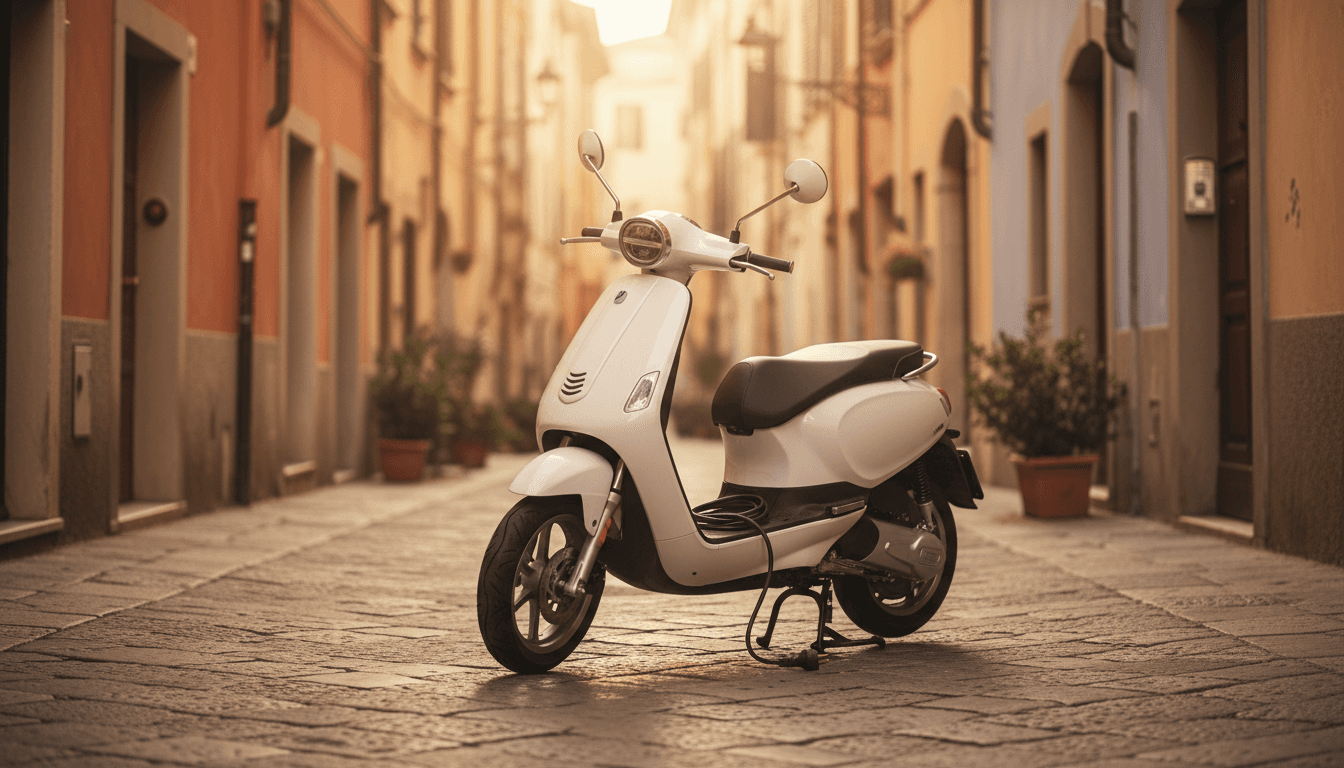
Type electric scooter without a licence into Google in Italy and the autocomplete finishes the phrase for you. It is one of the most persistent queries in the Italian motoring landscape, fed by loosely worded classified ads and a misunderstanding that has been circulating for years. The answer allows no nuance: there is no road-legal electric scooter in Italy that can be ridden without a licence of some kind.
While the myth holds, the market is telling a parallel and far more interesting story. ANCMA registration data for July 2026 shows electric two-wheelers up 20.07% with 1,340 units registered in the month, and 6,717 vehicles over the first seven months of the year, a 20.59% rise. Inside that healthy headline, though, sits a crater: electric mopeds — precisely the category people have in mind when they search for something licence-free — fell 48%.
Why licence-free does not exist
Electric scooters have no engine displacement, so two technical figures decide everything: top speed by design and continuous rated motor power. An L1e electric moped cannot exceed 45 km/h or 4 kW of continuous rated power. To ride one you need an AM licence, the category Italians still call the patentino, available from the age of 14 after a theory exam and a practical test.
Article 116 of the Italian Highway Code sets the rules. Riding without the corresponding licence carries an administrative fine of between 5,110 and 30,660 euros, plus a three-month impoundment of the vehicle and confiscation for repeat offences. The offence was downgraded from criminal to administrative by legislative decree 8/2016, but it remains one of the most expensive penalties in the whole code.
On top of that come the obligations attached to any type-approved vehicle: registration with a number plate, third-party insurance, and an approved helmet for the rider. A passenger may be carried on a moped only from the age of 16, and only if the vehicle is approved for two people.
The only genuinely licence-free electrics
There is a grey area, but it is not the one people imagine. The only electric vehicles that can be ridden in Italy with no licence at all belong to entirely different legal categories: pedal-assist bicycles, whose motor cuts out above 25 km/h and only helps while you pedal, and electric kick scooters, which now have their own rules on helmets, insurance and urban use.
So when a listing promises a licence-free electric that reaches 45 km/h, it is describing a moped. Full stop. If the seller insists otherwise, treat that as a signal worth carrying through the rest of the negotiation.
What the 2026 numbers actually say
This year's ANCMA figures are useful because they cleanly separate two worlds that the public tends to blur. In May 2026 electric scooters — the larger category, equivalent to 125s and above — jumped 62.73% to 1,131 units. In the same month electric mopeds slipped 15.23%, down to 295 registrations. By July the gap had widened into the 48% drop that made headlines.
The explanation is not mysterious. The 45 km/h electric is squeezed by three constraints at once: performance that bars it from faster roads and many ring roads, a list price that often brushes against that of a far more versatile combustion 125, and demand that has drifted upmarket as riders realised that a standard car licence already lets them ride a 125 in Italy. The 2026 incentives for L1e vehicles — a 30% discount up to 3,000 euros, rising to 40% and 4,000 euros with a trade-in — inflated a few months and then left a vacuum once the funds ran dry.
What that means for the used market
A shrinking new-vehicle market does not mean a bad product. It means value has migrated to the used channel. For electric mopeds, second-hand is now the rational route, because depreciation over the first three years is steep on a machine that remains functionally ideal for a pure urban commuter.
Models like the Askoll XKP in its 45 km/h form quote around 87 km of range with twin removable lithium-ion packs. The Piaggio 1 brought Pontedera build quality to the segment. The NIU NQi GTS, now a mature design, can be found at attractive money and quotes up to 110 km in its energy-saving mode with a full recharge in roughly three hours from a domestic socket. A 50-equivalent from Yamaha, with a 2.3 kW motor and a 1.9 kWh battery, is rated at 68 km. Those are homologation figures: in real riding, with cold weather, hills and stop-start traffic, plan for a 25–30% haircut.
The battery is ninety per cent of the purchase
On a used electric, the mechanicals barely matter. There is no clutch, no engine oil, and brakes last longer thanks to regeneration. What matters is the battery, and assessing it is genuinely hard. No tool available to a private buyer will tell you how many cycles the pack has done, how it was charged, or whether it has suffered deep undervoltage or serious heat excursions.
Hence a few working rules. First, a natural degradation of 2–3% a year is normal, and three years is the threshold beyond which decay starts showing up tangibly in a scooter's range. Second, beware the low-mileage paradox: a moped left standing for months with a flat battery can be in worse shape than one ridden daily, because prolonged storage at a low state of charge does more harm than regular cycling. Third, ask for a state-of-health test at an official dealer or specialist centre. It typically costs between 50 and 120 euros and is the only way to replace an impression with a number.
If the packs are removable, check that all of them are present, that the original charger is included, and that the contacts show no corrosion. Replacing a pack can swallow a serious share of what the whole machine is worth, so looking up spare-part prices before you commit is the single check that saves the most money.
Paperwork: three minutes that prevent months of trouble
Before shaking hands, confirm that the ownership certificate and the registration document both name the person actually selling, that the vehicle carries no administrative holds or liens — a PRA search costs a few euros — and that the type approval on the documents really reads L1e if your plan is to ride it on an AM licence. Some models exist in both moped and motorcycle versions under the same commercial name, and buying the faster variant by mistake means you cannot legally ride it. The transfer of ownership must be completed within 60 days of the signature being certified.
On the regulatory front, the new EU driving licence directive 2025/2205, which member states must transpose by the end of the decade, does not upend this picture for category AM: it leaves each country free to set the minimum age, and Italy currently keeps it at 14. The more visible changes affect other categories, starting with earlier access to a car licence.
The takeaway
The licence-free electric scooter does not exist, and hunting for one usually leads to a moped that has been described carelessly. But the question behind the search is fair enough: plenty of people simply want the cheapest, least demanding electric machine for getting to work. In 2026 the best answer is not a new moped — a shrinking category sold at full price — but a two- or three-year-old used electric L1e with a certified battery and clean paperwork, ridden on an AM licence you can hold from 14. Add up road tax, which is often reduced for electrics, modest insurance and charging that costs a few cents per kilometre, and the running total stays among the lowest in Italian mobility.
Further reading
- Electric two-wheelers, July 2026: total up 20% while mopeds fall 48% — Moto.it
- Motorcycle and scooter market, May 2026: ANCMA data — HDmotori
- Article 116, Italian Highway Code — Brocardi
- Riding a moped without a licence — ACI Legal Review
- Electric scooter without a licence: the rules — Virgilio Motori
- AM licence: cost, exams and documents — Sicurmoto
- Buying a used electric scooter — Dueruote
- EU Directive 2025/2205 on driving licences — Patente.it
Further reading
- Elettrico a due ruote, luglio 2026: il totale sale del 20% ma i ciclomotori crollano del 48% — Moto.it
- Mercato moto e scooter maggio 2026: le vendite crescono del 8,45% — HDmotori
- Art. 116 Codice della Strada - Patente e abilitazioni professionali per la guida di veicoli a motore — Brocardi
- Guida ciclomotore senza patente — Rivista Giuridica ACI
- Guidare lo scooter elettrico senza patente, i falsi miti: la verita — Virgilio Motori
- Patente AM: costo, esami e documenti necessari — Sicurmoto
- Scooter elettrico usato: guida all'acquisto — Dueruote
- Direttiva UE 2025/2205 - Patente di guida — Patente.it
Related articles
Electric Scooters Without a License in Italy
Plenty of listings promise electric scooters with no license, plate or insurance needed. Here is what the Italian Highway Code actually says, and how to spot a properly road-legal used scooter before you buy.
BMW Electric Scooters: CE 04 vs CE 02 Guide 2026
CE 04 vs CE 02 compared: 2026 prices, licenses, range, and how the trade-in Ecobonus can make a new one almost as cheap as a used one.