Compact SUV or city car: which one suits city life
Compact SUV or city car for urban life? Space, costs, parking, visibility and safety compared, with the numbers and the right questions to pick the car that suits you and a small family.
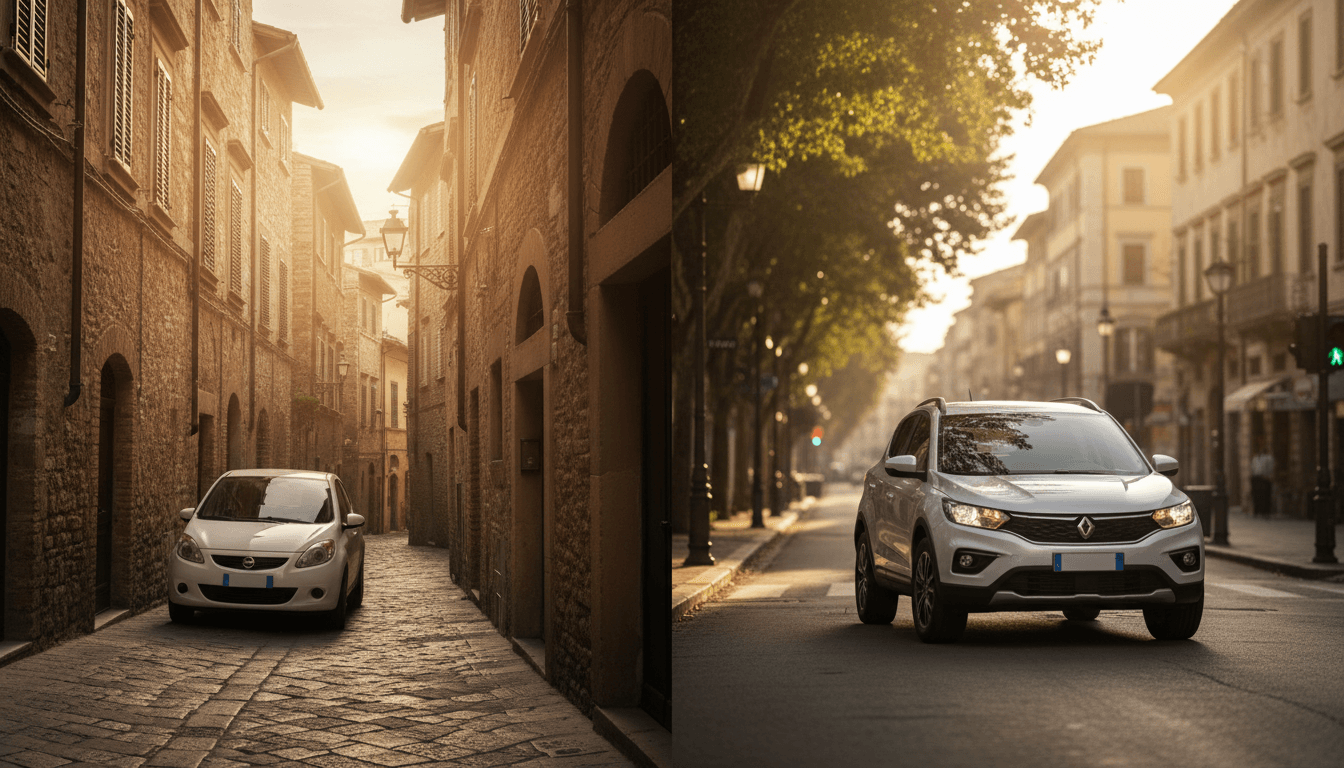
Anyone who lives in a city and needs to change car tends to face the same fork in the road: a compact SUV, tall and reassuring, or a small city car, nimble and pocket-sized. They are two philosophies applied to the same daily grind of traffic lights, tight parking and restricted-traffic zones. There is no answer that fits everyone — it depends on how many people you carry, where you park at night and how much you are willing to spend each year. Let us go through it point by point.
Interior and boot space
A segment-A city car is usually 3.5 to 3.7 metres long: brilliant at slipping into any gap, less generous once three passengers or a child seat need to fit in the back. Boot volume runs from a tight 185 litres on some three-door models to around 225 litres on a Panda-sized car — enough for the weekly shop, not for a pram plus suitcases. A compact SUV, essentially a raised B-segment, typically stretches to 4.1-4.4 metres and offers 380-550 litres of boot, close to double. The extra ride height also means an easier step-in, a taller seat and, for anyone with a bad back or a toddler to buckle up, far less bending. If yours is a household of three or four and the boot regularly swallows a buggy or sports kit, the SUV wins hands down; if you travel one or two up and the boot only carries groceries, the city car is more than enough.
Running costs and consumption
This is where the gap bites all year round. A city car uses roughly 4.5-5.5 litres per 100 km in real driving; a compact SUV, heavier and less aerodynamic, often sits at 6-7.5. Over 10,000 km a year that is 150-200 extra litres of fuel — very roughly 250-350 euro. Italy's road tax, the bollo, tracks kilowatts and emissions class, so the more powerful engines typical of SUVs attract a higher bill. The same logic applies to the ownership transfer, the passaggio di proprietà, because the provincial IPT rises with engine power. Third-party insurance, finally, tends to cost more on a vehicle that is worth more and pricier to repair. As the ACI cost-per-kilometre tables show, it is exactly these lines — fuel, road tax, insurance and servicing — that make up the real annual outlay. The city car stays the cheaper thing to run; the SUV asks for a premium you should budget for before you buy, not after.
Parking and manoeuvrability
In town, centimetres matter. A standard bay is about 2.3-2.5 metres wide and five long: a 3.6-metre city car drops in with room to spare and manages herringbone spots a SUV has to skip. A small car turns in a circle of around 9.5 metres; a compact SUV often needs more than 11, and you feel it in U-turns and spiral car parks. Width counts too — many SUVs exceed 1.80 metres excluding mirrors, which complicates narrow condominium garages and toll booths. As for restricted-traffic ZTL zones, neither body style gets a free pass: access depends on the Euro emissions class, not on ride height. That said, hybrids and electrics in both categories often enjoy concessions in many towns.
Driving position and visibility
The SUV's most quoted advantage is the high seat: you sit above the traffic, see farther and spot a hazard sooner. It is a genuine comfort, especially in long queues. It has a flip side, though — thicker pillars, a higher tail and a long bonnet create rear blind spots that make sensors and a camera almost essential. The lower, shorter city car makes you feel less protected but makes it wonderfully easy to judge where the bumper ends, a real help in centimetre-perfect manoeuvres. In short, the SUV gives the better overview on the move, the city car the better control when parking.
Safety: perception versus reality
The sense of safety inside an SUV comes from mass and height, but real protection is certified by crash tests. Euro NCAP scores each model on its own merits: several recent city cars now achieve strong results, while not every SUV automatically tops the table. It is true that, in a collision between two vehicles, greater mass helps whoever sits in the heavier one; but a tall SUV has a higher centre of gravity and behaves differently in an emergency swerve. The advice is to check the Euro NCAP score of the specific version and its ADAS package — autonomous emergency braking, lane keeping, pedestrian detection — which today count as much as the shell. A feeling of solidity should not stand in for the data.
How to choose for city and small-family use
Start with three concrete questions. First: how many people and how much cargo do you usually carry? If two adults or two child seats ride in the back most days, lean SUV; if you are nearly always solo or two up, the city car simplifies your life. Second: where do you park overnight? A tight garage or crowded streets reward the small car; a wide space or a courtyard removes the SUV's only real drawback. Third: how much can you spend per year? Add up fuel, bollo, insurance and servicing, not just the sticker price. Then book a test drive of at least twenty minutes mixing town and faster roads, check the service book and the roadworthiness history, and judge a used car with the same care as a new one: on platforms such as VendiVoce you can line up private and dealer listings and compare them at your leisure.
The bottom line
There is no absolute winner, only the right car for you. The city car is cheaper to buy and to keep, parks anywhere and is unbeatable in dense traffic; the compact SUV hands you space, a commanding seat and a view of the road many find reassuring, at the cost of higher fuel, tax and insurance. If your city is narrow and your family small, the little car is often the more rational pick; if cabin space and out-of-town trips genuinely matter, the compact SUV earns its premium. Decide by looking at your real mileage, not at the image the car projects.
Sources and further reading
- ACI — Automobile Club d'Italia: running costs, road tax and IPT (aci.it)
- Quattroruote: road tests and comparisons (quattroruote.it)
- Euro NCAP: safety ratings (euroncap.com)
- Al Volante: buying guides (alvolante.it)
Further reading
Related articles
Opel Frontera Manual 2026: New or Go Used?
Opel just launched the Frontera Start, a 100-hp manual entry point priced from 17,900 euros on promotion. Here is what the fine print hides, and when a used compact SUV still wins.
Best Cheap Used City Cars in Italy 2026
With no new city car left under 10,000 euros in Italy, used is the only route to a cheap runabout. Here is what a used Panda, 500, Aygo X, Picanto or i10 really costs, what insurance and road tax add on top, and what to check before you sign.