Titanium Is Coming to Lead-Acid Batteries: What It Actually Means for Your Used Car Today
A new study proposes a titanium current collector to make lead-acid batteries lighter and longer-lived. It's still a lab prototype — here's what actually matters today, from the warning signs of a dying battery to real replacement costs.
A lab headline that seems to concern everyone (but doesn't, yet)
In late August 2026 a new technical study revived an idea battery engineers have circled for at least a decade: replacing the current collector in lead-acid batteries with a titanium layer, to make them lighter, tougher and faster to charge [1]. The way the story spread in technical circles, framed as somewhere between breakthrough and hype, tells you most of what you need to know: it is genuinely promising research, and it is still a long way from your engine bay. It is worth understanding anyway, because the humble 12-volt battery is, alongside tyres, the most underrated component on any used car.
What the titanium-collector study actually says
In a conventional lead-acid battery, the current collector is the metal structure that carries electrons from the active material to the external terminals; it stores no energy itself, but without it the electrode cannot talk to the rest of the circuit. In bipolar batteries, where several cells are stacked tightly into a single compact block instead of being wired together externally, that same component also has to carry the mechanical load of the assembly, rather like the frame that supports a battery pack. Titanium's historical problem in this role is that it oxidises on contact with the electrolyte and loses conductivity, which is why researchers have spent years testing intermediate solutions such as conductive ceramic sub-oxides (known in the literature as Ebonex) coated onto a titanium foil. The new design instead proposes an asymmetric collector that distributes titanium differently across the two faces of the cell, adding structural strength where support is needed and conductivity where current needs to flow. By the researchers' own account, it remains a laboratory prototype, not a component ready for a production line.
Why a bipolar battery would change the rules
Compared with traditional lead-acid batteries built from prismatic cells wired together, bipolar architecture promises less weight, less material, shorter charging times and more usable cycles before degradation sets in. Those are precisely the limits that today separate a budget starter battery from one engineered to survive the stress of a start-stop system. If the titanium research genuinely solved the trade-off between corrosion resistance and mechanical strength, the payoff would land not so much on electric cars, which run on lithium chemistry, but on the 12-volt auxiliary batteries still fitted to the overwhelming majority of vehicles on Italian roads, electric ones included. But the gap between a research paper and a parts-shop shelf is typically measured in years, often a decade: this same bipolar titanium-collector idea has been studied, in various forms, since at least 2014.
Meanwhile, the real story is already under your bonnet
While the titanium research plays out, the battery already fitted to your car is working harder than most drivers assume. A start-stop system, now standard on nearly every car sold in Italy over the past decade, switches the engine off and on up to 300-400 times a day in heavy city driving [2]. Every restart is a small electrical shock that a traditional starter battery, designed for a handful of cold starts per day, was never built to absorb indefinitely. That is why, from around 2010 onward, manufacturers progressively moved away from classic flooded lead-acid batteries toward EFB and AGM technology.
AGM, EFB, or plain lead-acid: what's actually under your bonnet
EFB (Enhanced Flooded Battery) is an evolution of the traditional battery, with reinforced plates and a microfibre separator that improves cycle resistance; it equips cars with basic start-stop and no brake-energy recovery. AGM (Absorbent Glass Mat) is the premium tier, with the electrolyte held in glass-fibre matting rather than sitting free in the case; it withstands far more charge-discharge cycles and is almost always mandatory on cars with intensive start-stop and regenerative braking [3][4]. The practical rule when replacing one is simple but often ignored: if the car left the factory with an AGM, it needs an AGM back, because the energy-management control unit is calibrated for that chemistry; if it came with an EFB, you can stay on EFB or upgrade to AGM for longer life, but never go the other way. Before ordering the cheapest battery you find online, check the label on the one currently fitted — the type code and the EFB or AGM designation are printed directly on the case.
The warning signs before a battery strands you
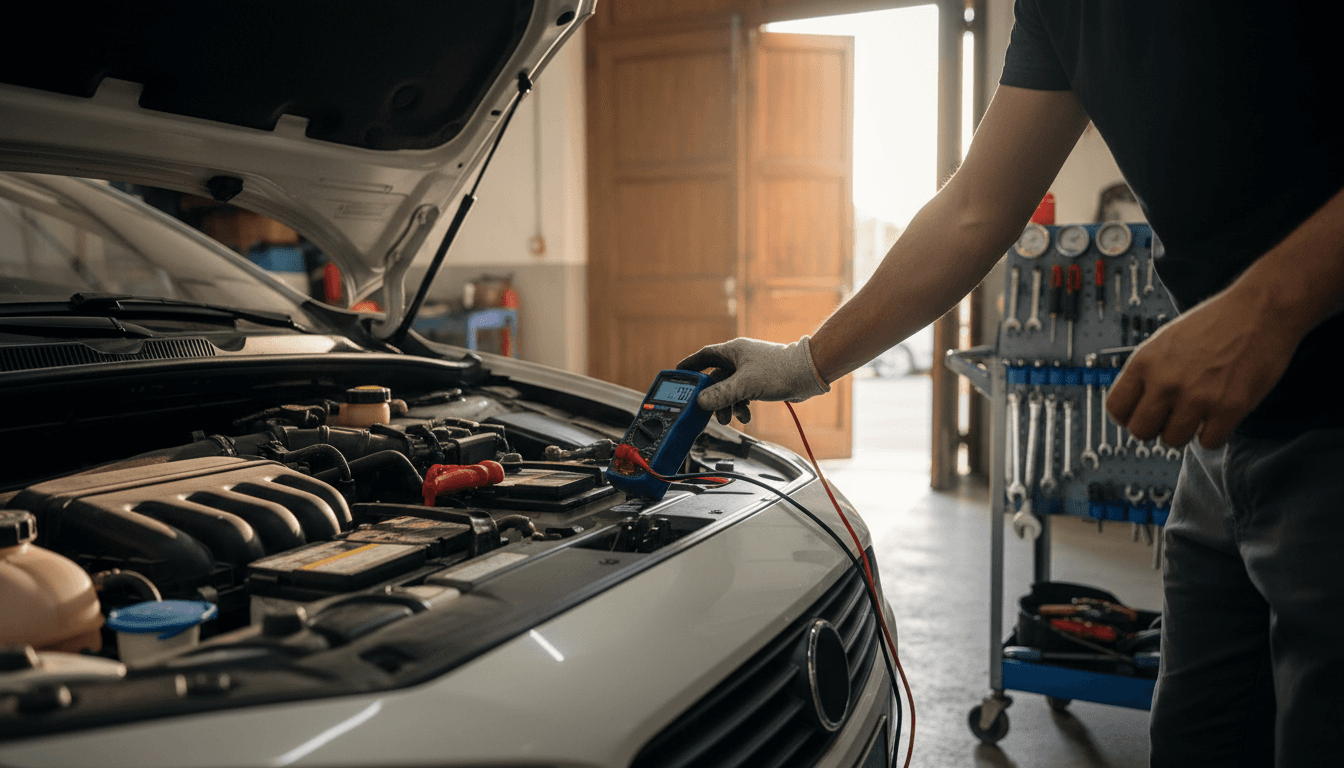
A starter battery's average lifespan runs from 3-4 years under urban, short-trip use up to 6-7 years with regular mileage and a mild climate [5]. The warning signs, roughly in order of severity, are: the starter motor cranking noticeably slower than usual; headlights and interior lights looking dimmer at low revs; the battery warning light coming on; and finally the familiar single click with no start, which means the battery is essentially flat. A cheap, quick check uses a multimeter with the engine off: a healthy battery reads 12.6-12.7 volts, anything below 12.4 volts counts as discharged, and below 12.0 volts it almost always needs replacing [5]. Many independent auto-electricians and tyre shops run this check for free in a few minutes, and it's a good habit to build before winter, when cold weather further cuts the usable capacity.
What replacement actually costs, and how to choose correctly
For a traditional lead-acid battery, the part itself typically runs €50-150 depending on amperage and capacity, with fitting adding another €20-80; a full job at a general workshop often lands around €100-150 [6]. EFB and especially AGM batteries cost roughly double a standard battery of equivalent capacity, with a full replacement usually landing around €100-120 for an entry-level EFB and potentially exceeding €200 for a high-capacity AGM [3]. Always ask for the old battery to be recycled — it's a legal requirement and almost always included in the price. Lead-acid batteries are among the most recycled consumer products in existence, and the recovered lead routinely goes straight back into new batteries.
Buying used: why the battery deserves a look before the price
Buyers evaluating a used car rarely think about the battery, yet it's one of the most common hidden costs in the first few months of ownership, especially on models with start-stop and an infotainment system that stays in standby. Before agreeing a price, it's worth asking the seller when the battery was last replaced, checking the date code printed on the label (often a month/year stamp), and, where possible, having it tested with a multimeter or a professional tester that also measures cold-cranking amps (CCA), not just resting voltage. A weak battery isn't a reason to walk away from an otherwise good deal — it's a concrete bargaining point: €100-150 of negotiating room almost always covers the replacement.
Titanium research, if and when it moves out of the lab, will make tomorrow's batteries lighter and longer-lived. But the battery that decides whether your used car starts tomorrow morning is the one already under the bonnet, and a five-minute check before winter is worth more than any technology still on paper.
Further reading
- Collettore in titanio per batterie al piombo bipolari — InsideEVs Italia
- Batterie auto EFB e AGM per Start-Stop: quali differenze? — SicurAUTO.it
- Guida Batterie Start Stop: EFB e AGM 2026 — GoBattery.it
- Sostituzione della batteria start-stop — Varta Automotive
- Cambio batteria auto: quando e come sostituirla — Auto.it
- Quanto costa cambiare la batteria dell'auto? — Cronoshare.it
Related articles

Winter Tires in Italy 2026: Dates and Fines
Italy's winter tyre law kicks in on 15 November 2026: dates, fines, the real difference between M+S and 3PMSF, and what to check on the tyres before buying or selling a used vehicle this season.
Diesel Particulate Filter: Warning Light and Cost
A lit DPF warning light is not a breakdown, it is an alert. Here is what cleaning, regeneration or replacement really costs, what to check before buying a used diesel, and why a removed filter costs far more than it seems to save, as inspection checks get stricter from 2026.