Car battery replacement: when to change and cost
How long a 12V battery lasts, the warning signs, real part and labour costs in Italy, EFB versus AGM and why a new battery must be registered on stop-start cars.
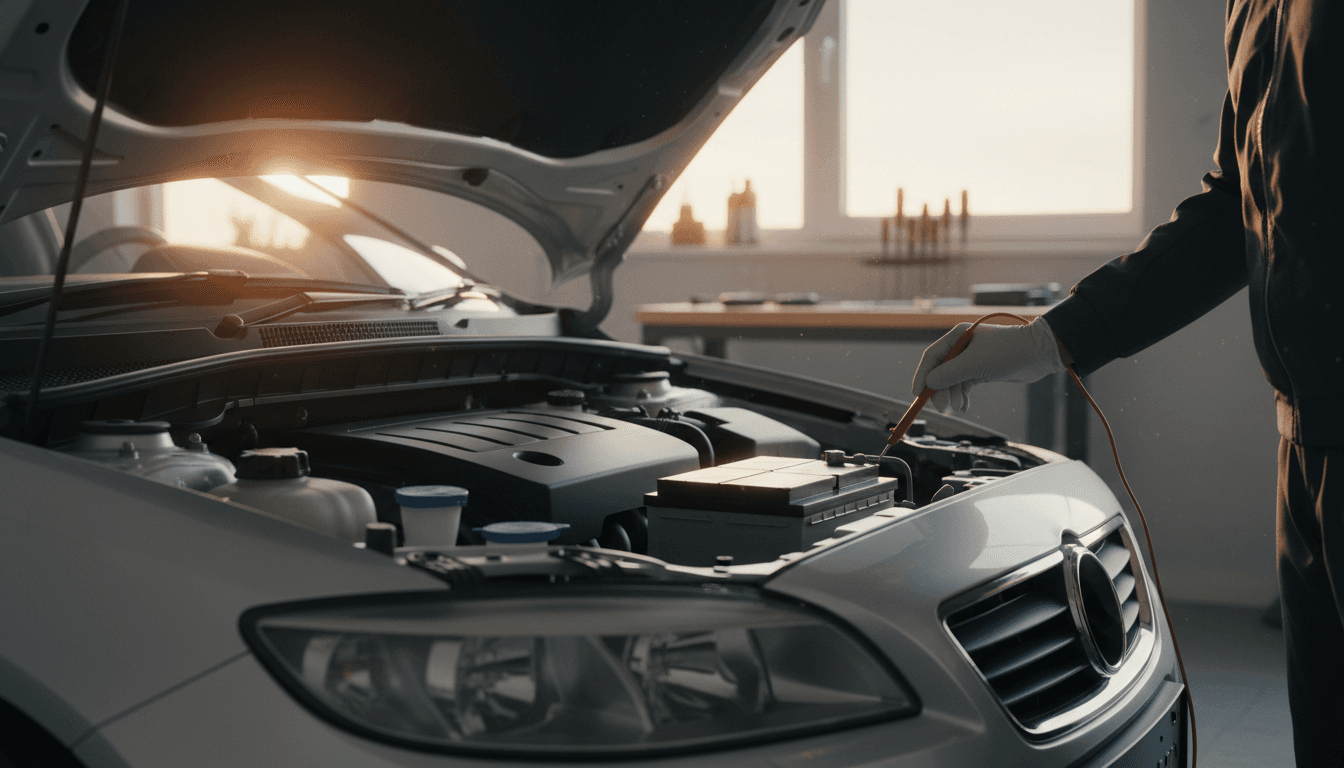
The 12-volt battery is the part most drivers only think about when the car refuses to start. Yet it has a limited life, usually warns you well before it fails, and a wrong replacement can upset stop-start and parts of the on-board electronics. This guide covers how often to change it, how to tell it is time, what it costs in Italy and how to pick the right type.
How long does a car battery last?
There is no expiry date printed on a battery. Italian outlet Auto.it puts normal service life at 4 to 6 years [2], while AutoScout24 suggests replacement every three to five years as a guideline rather than a fixed rule [1]. The range is wide because usage habits matter:
- Short, repeated trips: the alternator cannot refill what the starter takes out.
- Long periods parked: a car left for weeks slowly discharges and the battery degrades.
- Hard cold or extreme heat: both shorten service life [1][2].
- Heavy electrical load: climate control, heated seats, dashcams and add-on accessories eat into the reserve.
If your car has stop-start, the battery works much harder because the engine restarts at every traffic light. Have it checked regularly from around year three.
Signs the battery needs replacing
The sources agree on a fairly clear list [1][2]:
- Slow starting: the starter turns over reluctantly, especially when cold or after a few days parked.
- Dimmer lights: headlights and interior lamps lose brightness, especially at idle.
- Voltage dips: with several devices on, the dashboard or radio misbehaves.
- Stop-start stops working: the system disables itself because the control unit sees insufficient charge.
- Warning light or sluggish electrics such as slow windows.
A car that will not start is not automatically a battery problem. The starter motor, the alternator or a corroded terminal can be the cause, so diagnose before you spend.
Testing the battery with a multimeter
With a multimeter and the engine off, Auto.it says a healthy battery reads 12.6 to 12.8 V; 12.0 to 12.4 V means low charge and anything under 12 V is critical [2]. One reading is not enough, though, because resting voltage does not show how the battery behaves under load. The reliable check is a cranking or conductance test, which simulates the starting load and which many workshops and parts shops run in a few minutes.
If the voltage is low but the battery is fairly young, try recharging it first: it may simply have been drained by a long stand or a light left on.
How much does it cost?
According to AutoScout24, the battery itself costs 50 to 200 euros depending on size, capacity in Ah, cold-cranking amps and technology, while workshop labour runs 30 to 100 euros [1]. Another trade guide quotes 50 to 120 euros for a good conventional battery. Put together, a complete job lands roughly between 80 and 300 euros. An AGM battery for a car with advanced stop-start sits at the top of that range, a standard battery for an older city car at the bottom.
Do not forget disposal: a spent battery is hazardous waste, and dealers and authorised workshops take it back, often included in the replacement service [2]. It must never go in household waste.
Standard, EFB or AGM: choosing correctly
This is where the costly mistakes happen. There are three main technologies:
- Conventional lead-acid: suitable for cars without stop-start.
- EFB (Enhanced Flooded Battery): built for basic stop-start, with better charge-discharge cycling.
- AGM (Absorbent Glass Mat): sealed, with much higher charge acceptance; recommended for systems with braking energy recovery [2][3].
Auto.it gives a clear rule: on a stop-start car, keep the same technology; moving from EFB to AGM can be considered, while downgrading is discouraged [2]. SicurAuto adds that fitting a conventional battery in a stop-start car defeats its fuel-saving purpose, shortens battery life and, in more complex systems, can cause control-unit faults [3]. Also bear in mind that the battery currently fitted is not necessarily the right one if it was replaced badly in the past: the reference is the owner's manual or the model's technical data.
Registering the new battery (BMS)
On recent cars a sensor lets the control unit monitor state of charge. AutoScout24 explains that on stop-start cars the charge-monitoring system must be reset after installation [1]; Auto.it adds that on many cars with BMS or IBS, registration or coding with diagnostic equipment may be needed, and skipping it can shorten battery life and disturb stop-start [2]. In practice: if you drive a 2015-or-later car with stop-start, ask beforehand whether the workshop performs the registration and whether it is in the quote. DIY is discouraged for exactly this reason.
What it means when buying or selling a used car
When buying a used car, ask when the battery was last replaced and, if you can, request a conductance test: it is a cheap check that can justify negotiating a discount of a few tens or hundreds of euros. When selling, a recent battery of the correct type, with an invoice, is a concrete detail worth putting in the listing: it shows care and removes a common buyer worry. A strong cold start makes a great impression on a test drive.
The takeaway
- After year three, have the battery tested at least once a year, before winter.
- Do not rely on voltage alone: ask for a cranking or conductance test.
- Check the manual and keep the same technology (EFB or AGM) specified for your model.
- If the car has stop-start, insist on registration of the new battery.
- Realistic budget: 80 to 300 euros for part and labour, with the old battery taken back.
Sources / Further reading
- AutoScout24, Sostituire la batteria dell'auto: quando farlo, come si fa e il costo (13 May 2025).
- Auto.it, Cambio batteria auto: quando e come sostituirla (23 Feb 2026).
- SicurAuto, Batterie auto EFB e AGM per Start-Stop: quali differenze? (2017).
Further reading
Related articles
Brake pads: when to replace them and the cost
How many kilometres brake pads and discs last, the wear signs not to ignore, indicative costs and what to check on a used car.
When to change car tyres: tread, DOT and fines
The legal limit is 1.6 mm, but it pays to replace tyres sooner. Safer thresholds, the DOT code, the fine and what to check on a used car.