Bruno Sacco and the Mercedes That Never Age: What His Classics Are Worth Today
A fresh road-trip feature behind the wheel of Bruno Sacco's own 560 SEC has put the Italian designer back in the spotlight. Here is why the Mercedes models he shaped remain one of the steadiest buys in today's classic car market.
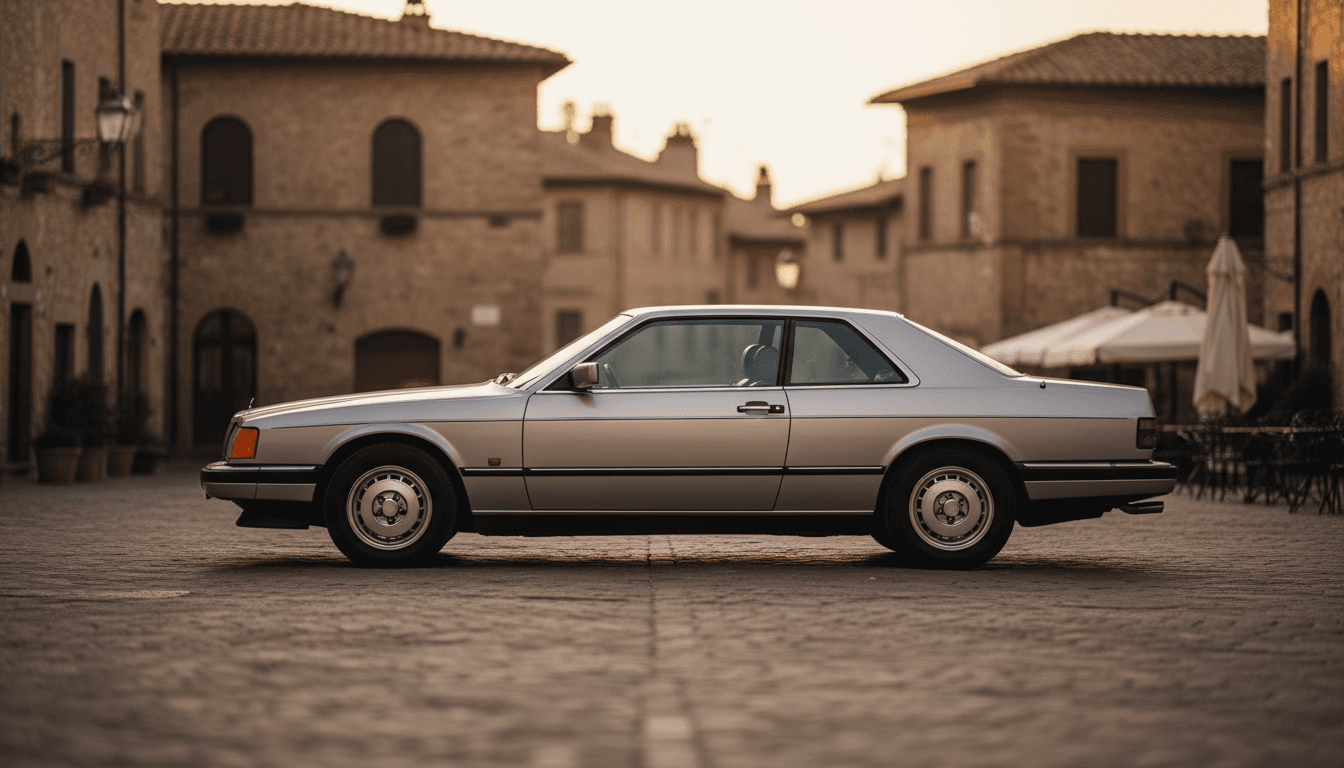
A Drive in the 560 SEC That Belonged to Bruno Sacco
Several automotive outlets, including Motor1 Italia, recently revisited a story worth retelling: the Mercedes 560 SEC (C126 series) that Bruno Sacco bought as his own personal car in 2017, already its fifth owner, and which now sits, unrestored, at the Mercedes-Benz Classic Center in Fellbach, Germany. The designer's daughter, Mercedes Sacco, donated the car along with original sketches and awards to the brand's historical archive. Every mark on the dark blue paint tells part of the story of the man who, for nearly a quarter century, decided what a Mercedes-Benz should look like.
The story is a good excuse to return to a very practical question for anyone buying or selling classics in Italy today: why do the Mercedes models Sacco shaped keep holding, or even gaining, value year after year, while other segments of the classic car market are losing ground.
Who Bruno Sacco Was, and Why He Still Matters
Born in Udine on 12 November 1933 and passing away in Sindelfingen on 19 September 2024 at the age of 90, Bruno Sacco was head of styling at Daimler-Benz from 1975 to 1999. Over that quarter-century he either designed outright or decisively shaped nearly every Mercedes road car: the W123 sedan, the R107 SL, the W126 S-Class, the W201 190 that debuted at the 1982 Paris Motor Show, the 1989 R129 SL, the W124 E-Class, and later the W140 S-Class and the original M-Class. For this body of work he received an honorary doctorate from the University of Udine and was inducted into both the Automotive Hall of Fame in Michigan and the European Automotive Hall of Fame.
His guiding rule was simple to state and brutally hard to execute: a Mercedes must always look like a Mercedes (what he called horizontal affinity), and it must never make an owner feel they are driving something outdated (vertical affinity). In practice: clean lines, balanced proportions, and details built to age gracefully instead of chasing a passing trend. The C126 series, whose flagship is the 560 SEC, is still described by many specialists as Sacco's absolute masterpiece.
What Sacco's Mercedes Are Actually Worth Today
This is the part that matters most for anyone weighing a purchase or a sale. Listings and valuations gathered over recent months paint a fairly consistent picture:
- Mercedes W123 (sedan and coupe, 1976-1985): well-kept, well-documented examples in Italy typically trade between 13,000 and 30,000 euros, with wide swings depending on engine, trim and condition.
- Mercedes 560 SEC / W126 (the same series as Sacco's own car): Italian listings range roughly from 20,000 to 65,000 euros; one 1988 example with 240,000 km was listed in Piedmont at around 59,900 euros in early 2026, while the German market runs closer to 25,000-52,500 euros.
- Mercedes W124 (E-Class, 1984-1995): for examples in condition suitable for Italy's ASI historic registration, values sit at a more accessible 5,000-7,000 euros, rising slowly but steadily.
- Mercedes R107 SL: repeatedly described by industry observers as a model that does not depreciate and tends instead to gain value each year; mechanically sound examples generally start around 7,000 euros.
A recent look at the Italian classic car market backs up the broader trend: buyers aged 45 to 60, who hold the greatest spending power, are chasing the cars of their youth, and the Mercedes 190E 2.3-16, another Sacco creation, is name-checked alongside icons like the Lancia Delta Integrale and the BMW E30 M3. Meanwhile, cars from the 1950s and 1960s are losing ground as the generation with a personal memory of them shrinks, a reminder that in the classic car market, personal nostalgia counts as much as technical rarity.
What to Check Before Buying a Sacco-Era Mercedes
Anyone weighing a purchase on VendiVoce should focus on a handful of points common to all these generations:
- Structural rust: wheel arches, chassis rails, trunk floor and headlight bowls, especially on the W123 and W126, which have often passed 35-40 years of age.
- Documented history: service books, ownership records, and, where present, Italy's ASI historic registration or an age certification, all of which directly affect resale price.
- Hydraulic systems and seals (suspension, central locking, folding roofs): expensive to repair if neglected for years.
- Original trim and paint: a poor restoration hurts value far more than honest patina, exactly the reasoning behind Mercedes-Benz Classic's decision to leave Sacco's own car untouched.
- Consistency between the original engine and trim: undisclosed swaps (a replaced engine, a manual gearbox on a car born automatic) should be clearly disclosed in any serious listing.
Why Now Is a Good Moment to Act
With the classic car market described as healthy and liquid but increasingly selective, models with a strong, recognizable design story, like the ones Bruno Sacco led, remain among the steadiest bets: they do not promise speculative spikes, but they hold value in a way that is increasingly rare in a segment where many other categories are cooling. For sellers, that means documentation and originality are worth foregrounding in a detailed listing. For buyers, it means stepping into a piece of Italian-German automotive design history without the risk of buying something fashionable today and forgotten tomorrow.
Further reading
- Ho guidato la Mercedes della leggenda del design Bruno Sacco — Motor1 Italia
- Bruno Sacco — Wikipedia
- Bruno Sacco obituary (1933-2024) — Octane Magazine
- Remembering Mercedes Design Icon Bruno Sacco With 8 Of His Best Benzes — Carscoops
- Le auto d'epoca e il cambio generazionale che sta ridisegnando il mercato — Ciclo Otto
- Auto d'epoca 2026: i modelli migliori e i prezzi — AutoScout24
Related articles
Classic Lancia Gamma: What It's Worth in 2026
Lancia has revived the Gamma name for a new 2026 SUV. But what is the original 1976-84 Gamma actually worth today? History, known flaws, real prices, and a pre-purchase checklist.
Buying a Classic Car in Italy: Tax, CRS & ZTL 2026
Before buying or selling a classic car or motorcycle in 2026, here is what the Certificate of Historic Relevance actually does, where a tax exemption still won't get you into a ZTL, and what you genuinely save on insurance.