ADAS: driver assistance systems explained
AEB, ACC, lane keeping, blind spot: what the ADAS acronyms really mean, how much they help, where they fail, which ones became mandatory in 2024, and what to check when buying a used car.
Driver assistance, not self-driving
Climb into any used car registered in the last few years and you are surrounded by acronyms: AEB, ACC, LKA, BSD, TSR. These are ADAS, Advanced Driver Assistance Systems. They are designed to prevent crashes or soften them, but they do not drive for you: the person behind the wheel is always responsible. Knowing what each system does, where it fails, and which ones are now mandatory helps you drive better and, just as importantly, judge a used car fairly before you commit to the passaggio di proprietà.
What the acronyms mean
Every abbreviation hides a specific job. These are the systems you will meet most often.
- AEB (Autonomous Emergency Braking) — automatic emergency braking. A radar or camera detects an obstacle and, if the driver does not react in time, applies the brakes on its own. It usually works alongside FCW (Forward Collision Warning), the alert that fires before the car intervenes.
- ACC (Adaptive Cruise Control) — cruise control that thinks. It holds your set speed but slows and accelerates by itself to keep a safe gap to the car ahead, most useful on motorways and in stop-and-go traffic.
- LKA / LDW (Lane Keeping Assist / Lane Departure Warning) — lane centring and departure warning. It reads the road markings: the basic version warns you, the active version nudges the steering back if you drift out of your lane without indicating.
- BSD / BSM (Blind Spot Detection) — blind spot monitoring. A light on the door mirror flags the vehicle you cannot see before you change lanes.
- TSR (Traffic Sign Recognition) — sign reading, above all speed limits, shown on the instrument cluster.
- ISA (Intelligent Speed Assistance) — intelligent speed help, combining TSR and map data to warn you when you exceed the current limit.
How much they actually help
These are not brochure gadgets. Data from Euro NCAP and from insurers show that automatic emergency braking cuts car-to-car rear-end crashes by roughly 38 to 50 percent and pedestrian collisions by around 30 percent. Adaptive cruise control lowers fatigue on long trips and reduces harsh braking in traffic. Blind spot monitoring removes a meaningful share of lane-change impacts, one of the most common scenarios on multi-lane roads. Sign recognition, finally, helps you avoid drifting over a limit through simple inattention. Taken together, these systems do not eliminate human error, but they make it cheaper: they turn many serious crashes into light knocks or near misses.
The real limits you should know
Precisely because they help, trusting them blindly is dangerous. The limits are concrete and worth keeping in mind.
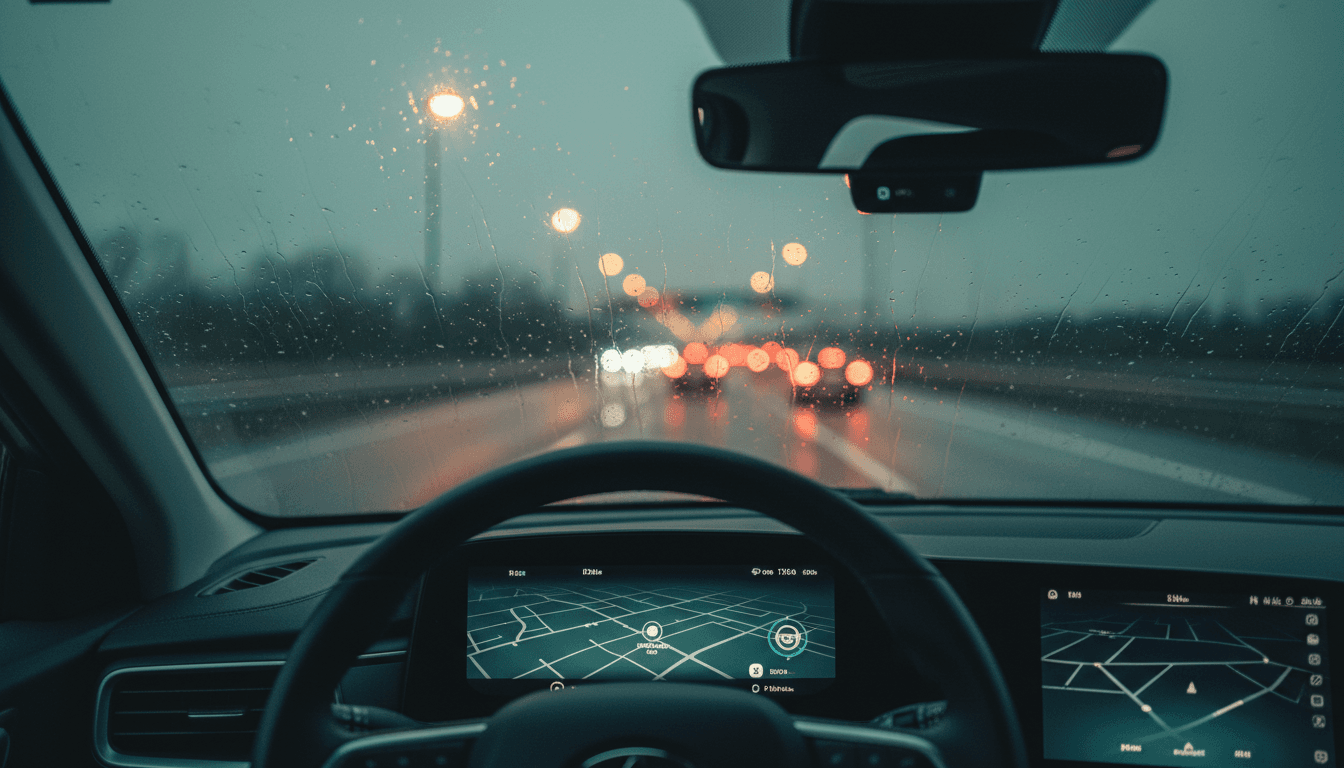
- Cameras and radar degrade in heavy rain, snow, fog, low sun, and when sensors are caked with mud, ice, or insects.
- Lane keeping needs clear markings: on broken tarmac, in roadworks, or where lines have faded, the system switches off or wanders.
- AEB may miss a pedestrian at night, an animal crossing, or a stationary obstacle met at high speed.
- TSR misreads dirty or covered signs and struggles with the temporary limits around roadworks.
- No ADAS on sale today is self-driving: they remain assistance. Hands on the wheel and constant attention stay mandatory, in law and in the terms of your licence.
Which ADAS are now mandatory
The framework comes from Regulation (EU) 2019/2144, known as the General Safety Regulation 2, or GSR2. It has applied since 6 July 2022 to newly type-approved models and since 7 July 2024 to every newly registered car. The systems it makes compulsory are automatic emergency braking (AEB), intelligent speed assistance (ISA), emergency lane keeping (ELKS), a driver drowsiness and attention warning (DDAW), a reversing camera or sensors, an event data recorder (the black box), an emergency stop signal, and a facility to fit an alcohol interlock. From 2026 an advanced driver distraction warning (ADDW) joins the list. One practical point matters: a car registered before those dates is not required to have any of this. That is exactly why, on a used car, equipment must be checked version by version and year by year.
What to check on a used car
Before you sign, give the assistance systems a few minutes.
- Confirm which ADAS that specific trim actually has: until a few years ago they were often paid options or packages, not standard, even on the same model.
- On the first start-up, make sure no error lights linger on the cluster for blind spot, braking, or lane systems.
- Take a safe test drive: engage adaptive cruise and lane keeping and feel whether they steer and brake cleanly, without jerks.
- Inspect the bumpers, windscreen, and mirrors: sensors and cameras damaged or badly replaced after a crash can behave incorrectly.
- Ask for the repair history. A windscreen replacement is the most common event and the one that most often demands a fresh calibration.
Maintenance, recalibration, and the revisione
After a windscreen replacement, a rear-end knock, or bodywork, the camera and radar must be recalibrated in a workshop through a set alignment procedure, a job that can cost anywhere from a few tens of euros up to 300 to 400 euros depending on the vehicle. A skipped or botched calibration means an AEB or lane system that reads the world wrongly, so it becomes less useful or even a nuisance. During the periodic revisione the examiner checks that warning lights show no faults, but specific, complete functional tests of ADAS are still being phased in: do not assume that a passed inspection certifies that every system works perfectly.
The bottom line
ADAS make driving safer when you know what to expect: they help a lot, they fail in hard conditions, and since 2024 they are mandatory on new cars. On a used car, check the real equipment of that trim, the absence of error lights, and the history of the windscreen and bodywork. When in doubt, a test drive and a recalibration quote are worth more than any spec sheet. If you want a car that is already well equipped, you can filter listings by trim and year, including on VendiVoce, while never losing sight of the core principle: the technology assists you, but you are the one driving.
Further reading
Related articles
Used cars: physical buttons or touchscreen?
From January 2026 Euro NCAP penalises cars that hide indicators, the horn and hazard lights inside touch menus. What that means if you are buying a used car from the all-touch years, and what to check before you sign.
Buying a Used Car With a Black Box: 2026 Guide
Buying a used car that already has an insurance black box installed is not a problem, but it is not an automatic perk either: the discount and the driving history stay with the previous owner. What Italy's 2024 data-portability law actually changed, and what to do before and after the ownership transfer.