Used cars: physical buttons or touchscreen?
From January 2026 Euro NCAP penalises cars that hide indicators, the horn and hazard lights inside touch menus. What that means if you are buying a used car from the all-touch years, and what to check before you sign.
Why Euro NCAP changed its mind about touchscreens
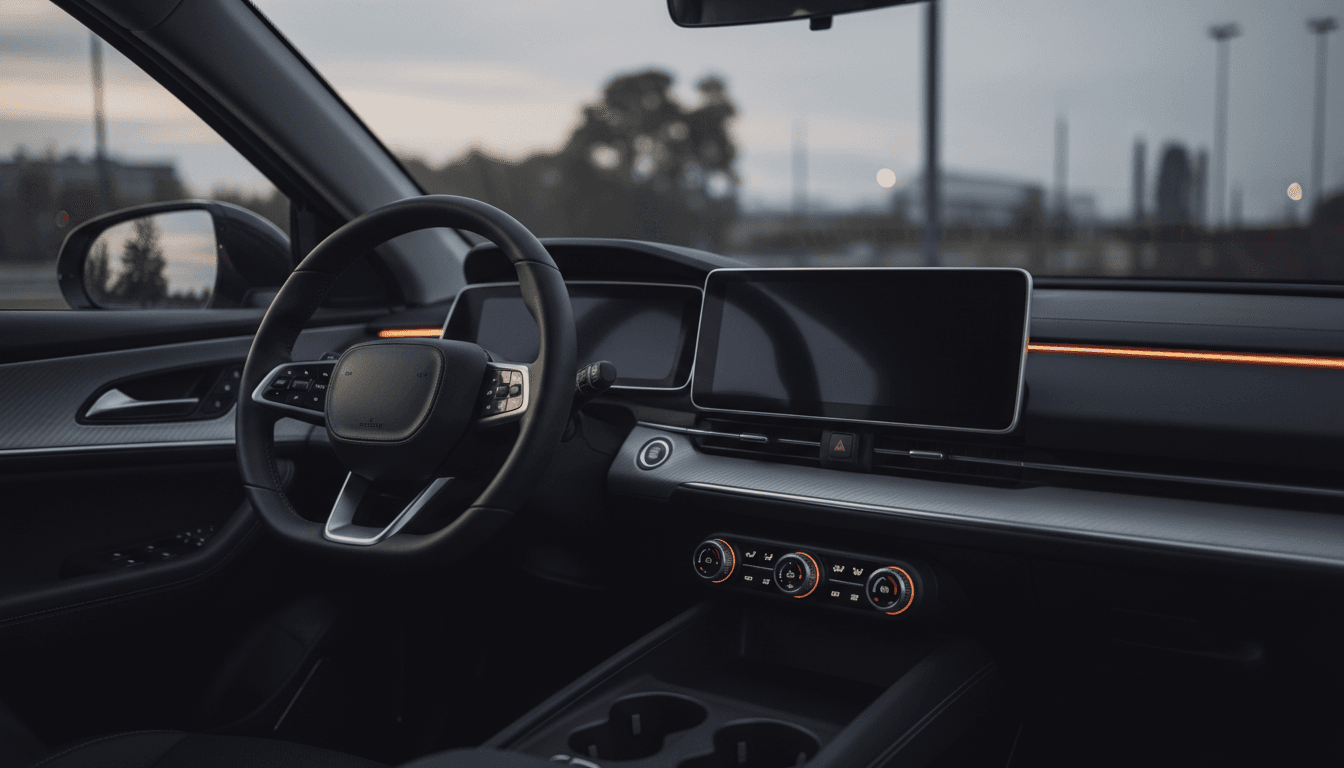
For a decade, carmakers stripped buttons out of dashboards and replaced them with ever larger screens, treating the touchscreen as shorthand for modernity. Euro NCAP, the body that awards the safety stars sold cars in Europe carry, has just reversed course. On 26 November 2025 it announced what it calls the broadest overhaul of its protocols since the star-rating system began in 2009, and for the first time it explicitly scores how much a car forces the driver to look away from the road to dig a function out of a touch menu instead of pressing a button.
The reasoning is not aesthetic, it is statistical. Crash-data analysis shows that the seconds lost hunting for a function inside a multi-layer touch menu, say to silence a warning or switch on the hazard lights, measurably raise risk compared with a physical control that can be operated from muscle memory, without looking down.
What the 2026 protocol actually requires
The technical basis is Euro NCAP Technical Bulletin SD 203, General Vehicle Controls Test Procedure, version 1.1 from October 2025, with an implementation date of 1 January 2026. It singles out a set of functions that must stay reachable through a dedicated physical control to earn full marks in the Safe Driving area, one of four pillars in the new rating alongside Crash Avoidance, Crash Protection and Post-Crash Safety: the horn, turn indicators, hazard lights, wipers, and the eCall SOS emergency activation. A car that buries even one of these inside a multi-level touch menu loses points, and under the new minimum thresholds per area, a full five stars becomes nearly out of reach.
This is not a ban on touchscreens as such. Navigation, infotainment and personalisation settings remain legitimately digital. The point is that functions used in an emergency, or simply used often while driving, have to stay reachable without thinking about it.
Automakers are walking it back, one by one
The reversal started before the new protocol, driven by customer complaints, and is now accelerating. Volkswagen's head of design, Andreas Mindt, has confirmed the return of dedicated buttons across several next-generation models, after the early ID.3 and ID.4 became a textbook case of the backlash, criticised for their fiddly touch sliders and a climate control buried in menus. Mercedes-Benz's software chief, Magnus Östberg, has admitted internal usage studies show traditional controls work better for the functions drivers reach for most often. Volvo has announced a gradual return to physical controls starting with its next models, after years in which volume and ventilation had moved almost entirely onto the central screen.
The shape emerging is hybrid: physical buttons for critical, frequently used functions, screens for navigation, connected services and personalisation. Not a step backward, but a course correction after years of touch being used even where it did not belong.
Buying used: know the all-touch generation
For anyone shopping for a used car today, this regulatory shift does not apply retroactively, a car already type-approved keeps its existing stars. But it does change the context you should be judging it in. Between 2019 and 2024, many manufacturers launched models that minimised physical buttons almost entirely, moving climate control, lighting, even the hazard switch into touch or capacitive-touch panels built into the wheel or dashboard. Anyone who drives one of those cars daily knows the frustration of turning on the fog lights or adjusting temperature by sliding a finger along a touch-sensitive strip, at night, on the motorway, in the rain.
It is not only a comfort issue. A touch panel built into the dashboard, when it fails, often requires replacing the entire control cluster or central display, and out-of-warranty repair costs are noticeably higher than swapping a single mechanical switch. That is worth factoring into the maintenance budget, especially on a used car that is about to age out of the manufacturer's warranty.
A test-drive checklist worth five minutes
Before signing for a used car, it is worth testing the interface with the same care you give the engine and the bodywork:
- Try switching on the hazard lights without looking down: on some 2019-2023 models it still takes tapping a screen icon, on others it remains a dedicated physical switch.
- Check how many steps it takes to adjust temperature or clear the rear windscreen: more than two taps through a menu becomes a real distraction once winter arrives.
- Check the touchscreen's own condition: lag, software glitches and uneven backlighting are common on older units and can be expensive to fix.
- Ask the seller whether software updates have been kept current: on many connected cars, touch functions improve, or degrade, with updates, and a neglected update history is a signal worth noticing.
What it means for resale value
With the new protocol rewarding physical controls, it is reasonable to expect the used market to start distinguishing, over the next few years, between cars with tactile controls for essential functions and cars that are touch-only, the way it already does for automatic gearboxes or driver-assistance systems. For sellers, mentioning in the listing that a car keeps physical controls for climate, hazard lights or volume can become a detail that safety-conscious buyers notice and value, especially anyone who has already lived with an all-touch car and does not want to repeat the experience.
The practical takeaway
The new Euro NCAP protocol does not suddenly make any car already on the road unsafe, but it marks a direction change for the whole industry that is worth knowing before buying used. Physically testing the most-used controls, checking how much touch hides the emergency functions, and weighing the repair cost of a failed touch panel are concrete checks that add to, not replace, the usual mechanical ones on tyres, brakes and the timing belt.
Further reading
- Euro NCAP announces 2026 protocol changes to tackle modern driving risks — Euro NCAP
- Crash test Euro NCAP, rivoluzione dal 2026: si cambia, le nuove regole — Quattroruote
- Euro NCAP, come cambiano i crash test: più peso ad ADAS, guida reale e sicurezza post-impatto — Quattroruote
- Auto: il 2026 probabilmente sarà l'anno che segnerà il ritorno dei pulsanti fisici a bordo — Motorionline
- Euro NCAP promuove i controlli fisici: dal 2026 serviranno i bottoni nelle auto, non solo touchscreen — DrCommodore
- Euro NCAP insiste sui tasti fisici: i tasti funzione dedicati non possono essere sostituiti dai touchscreen — Mondo Android
Related articles
Buying a Used Car With a Black Box: 2026 Guide
Buying a used car that already has an insurance black box installed is not a problem, but it is not an automatic perk either: the discount and the driving history stay with the previous owner. What Italy's 2024 data-portability law actually changed, and what to do before and after the ownership transfer.
Euro NCAP 2026: Three Chinese EVs Score Five Stars While Cupra's Raval Stumbles Without the Add-On
In Euro NCAP's early-September 2026 round, the Aion UT, Geely E2 and Leapmotor B05 all took full marks, while Cupra's Raval stopped at four stars without an optional package. What the numbers show, and what it means for anyone eyeing a budget EV.