The Town That Runs Its Own Gas Station: What It Reveals About Fuel and Used-Car Prices in 2026
In one Abruzzo village the mayor sells fuel almost at cost while the nationwide diesel excise discount expires. Here is what it actually means for anyone weighing a petrol, diesel or hybrid used car right now.
A Small Town, a Big Signal
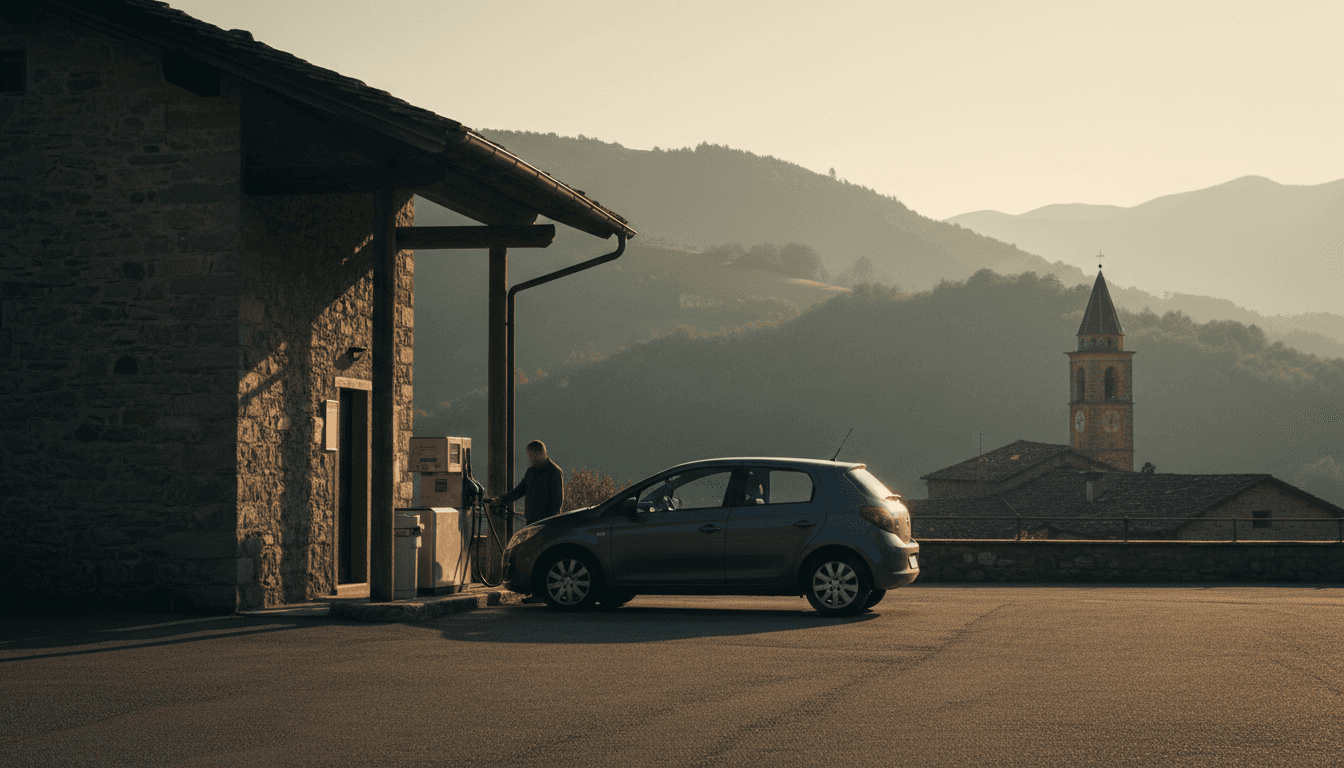
On 24 August 2026, several Italian newspapers reported on Valle Castellana, a mountain village of just over a thousand people scattered across nearly forty hamlets on the border between Abruzzo and the Marche. Its fuel station is not run by an oil company but by the town council itself. Mayor Camillo D'Angelo sells petrol at 1.75 euros a litre and diesel at 1.89, while the national self-service average that same weekend hovered around 2.00 euros for petrol and over 2.11 for diesel [1][2]. A gap of twenty to thirty cents a litre that, on a fifty-litre fill-up, means ten to fifteen euros saved every visit. It is little wonder queues have formed.
The story lands at the worst possible moment for Italian drivers: on 25 August 2026, the 17-cent-a-litre discount on diesel excise duty expires, a measure introduced months earlier and repeatedly extended to soften the impact of global oil-price swings [3][4]. Understanding what is happening to fuel prices is not just local colour. It is a core part of any used-car buying decision right now.
The Mayor's Petrol: How It Actually Works
The Valle Castellana story starts in 2018, when the area's only fuel station was on the verge of closing for lack of profitability. For residents spread across a vast mountain territory, that would have meant driving more than twenty kilometres just to refuel. The town council bought the station for roughly 60,000 euros and began running it as a public service: municipal finance staff purchase fuel wholesale and resell it close to cost, without the margin a private retailer would normally apply [1][5]. It is not an isolated act of goodwill so much as a live experiment showing how much of the pump price actually comes from the commercial chain itself. In Valle Castellana's case, that margin is worth up to thirty cents a litre.
Why Fuel Is Climbing Again Across Italy
By late August 2026, self-service petrol is holding stubbornly above 2 euros a litre and diesel on motorways is edging toward 2.17 euros, bringing the previous all-time high from March 2022 (2.229 euros for diesel) back into realistic reach rather than being just a memory [2][3]. The drivers are familiar: tension in the Middle East pushing crude prices up, an unfavourable euro-dollar exchange rate, and the expiry of the temporary tax relief that had been cushioning the increase in recent months.
What Changes From 25 August: A Moving Excise Mechanism
To avoid a sudden price spike, from 25 August 2026 the government activated a mobile-excise mechanism, using the extra VAT revenue generated by rising oil prices to temporarily lower fuel duties. Economy Minister Giancarlo Giorgetti earmarked 20.8 million euros to fund the measure [4]. Without it, analysts estimated diesel could climb to roughly 2.287 euros a litre, an increase of up to thirty cents a litre for both fuels compared with mid-August levels [3][4]. The mechanism does not erase the increase, only softens it: for drivers, it still means a pricier fill-up than a month ago, and fuel spending is once again a serious line item in household budgets.
Diesel, Petrol or Hybrid: What It Means for Used-Car Buyers Today
Against this backdrop, choosing a powertrain in the used market can no longer rest on sticker price alone. For an equivalent model, year and trim, a used diesel can still cost 2,000 to 3,500 euros less than a comparable full hybrid, but it tends to depreciate faster because of ongoing regulatory uncertainty around low-emission zones in major cities [6]. Petrol remains the cheapest option to buy and run for anyone covering under 10,000 kilometres a year, especially in urban driving. Diesel still makes sense for drivers who rack up heavy motorway or long-distance mileage every year, where lower fuel consumption offsets the higher price at the pump. Hybrids, despite a higher upfront cost, tend to pay for themselves between 10,000 and 20,000 kilometres a year thanks to lower urban consumption, and they hold their resale value more steadily, being seen as less exposed to future driving restrictions [6].
Total Cost of Ownership Matters More Than the Pump Price
Focusing only on this week's fuel prices is a common mistake. The right lens is total cost of ownership: purchase price, real-world consumption, maintenance, road tax and expected depreciation over the next three to five years. As a rule of thumb, for an equivalent model, cost typically ranks from petrol to diesel, then mild hybrid, full hybrid and finally plug-in hybrid, which remains the priciest option if it is not charged regularly [6]. But that ranking flips easily depending on real annual mileage: someone who drives little and mostly in town spends less with petrol even if diesel cost the same, while regular long-distance drivers quickly recoup the premium of a diesel or a hybrid.
Practical Tips for Anyone Shopping the Used Market Right Now
Before signing anything, calculate the kilometres you actually drive in a year, not an optimistic estimate. Compare fuel prices in your own area: regional differences, and the gap between city stations and motorway ones, can be worth several cents a litre, and Valle Castellana is a reminder that the retail margin is not the same everywhere. Do not let the headlines about rising prices scare you into a snap decision: work out total cost of ownership over three years, not just the cost of the first fill-up. Finally, keep an eye on the coming weeks. With the mobile-excise mechanism only just activated, further government measures before year-end are far from ruled out, and they could shift the relative value of each powertrain again.
The Takeaway
A small Abruzzo town selling petrol near cost price and the expiry of a national tax discount might look like two unrelated stories, but they point to the same lesson: fuel price remains the most volatile variable in a used-car purchase, and it deserves careful, powertrain-by-powertrain calculation before you decide what to buy.
Sources
- Il Fatto Quotidiano, A Valle Castellana la benzina la vende il Comune: -20 cent al litro, 24 August 2026
- Euronews Italia, Benzina alle stelle, ma qui il pieno costa 10 euro in meno: il Comune fa il benzinaio, 24 August 2026
- Quattroruote, Prezzi carburanti, benzina sopra i 2 euro: tra pochi giorni scade lo sconto sul gasolio, 20 August 2026
- Sky TG24, Carburanti, il taglio delle accise scade il 26 agosto: cosa può succedere ai prezzi, 24 August 2026
- Today.it, Valle Castellana (Teramo), dove la benzina si paga al prezzo di costo, 24 August 2026
- AutoSupermarket, Diesel o benzina usato nel 2026: quando conviene ciascuno, 15 July 2026
Further reading
- A Valle Castellana la benzina la vende il Comune: -20 cent al litro — Il Fatto Quotidiano
- Benzina alle stelle, ma qui il pieno costa 10 euro in meno: il Comune fa il benzinaio — Euronews Italia
- Prezzi carburanti, benzina sopra i 2 euro: tra pochi giorni scade lo sconto sul gasolio — Quattroruote
- Carburanti, il taglio delle accise scade il 26 agosto: cosa può succedere ai prezzi — Sky TG24
- Valle Castellana (Teramo), dove la benzina si paga al prezzo di costo (e si risparmiano fino a 30 centesimi al litro) — Today.it
- Diesel o benzina usato nel 2026: quando conviene ciascuno — AutoSupermarket
Related articles
BYD's 2026 Bonus: Up to €11,600 Off, Worth It?
In September 2026 BYD launched its own trade-in bonus worth up to €11,600, filling the gap left by Italy's exhausted state EV incentives. Here is how the scheme really works, and when selling your old car privately beats trading it in.
Italy's Used Car Market 2026: The Real Data
UNRAE's August figures show a used-car market that is flat on the surface but split underneath: diesel still at 42.9%, hybrids growing fast, and almost half of all cars traded are over ten years old. Here is what it means for sellers and buyers.