Odometer Fraud: How to Spot It Before You Buy Used
A survey published today finds nearly one in three used-car buyers runs into a tampered odometer. Here's how to check for free before you sign, and what a seller risks for doing it.
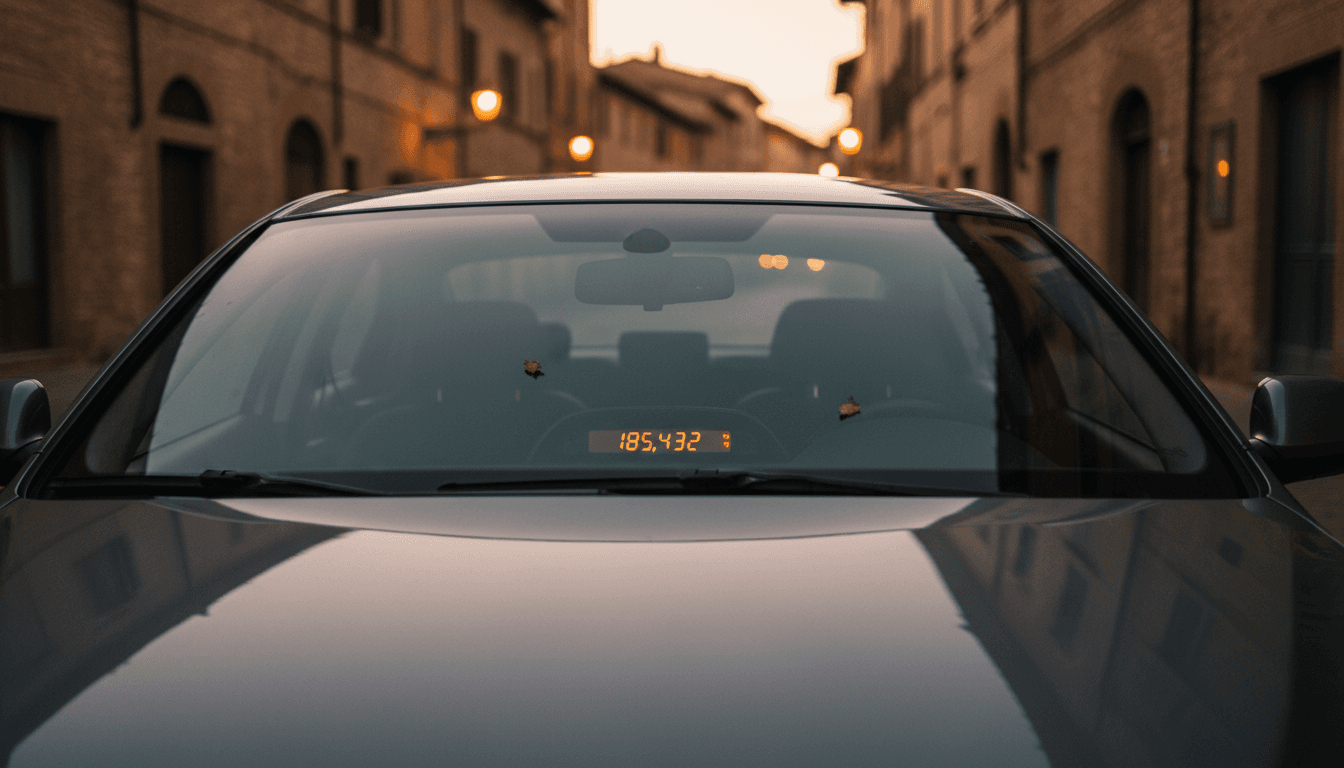
One buyer in three runs into rolled-back mileage, a survey published today says
A new carVertical survey of nearly 8,000 European drivers, covered today by Motor1 Italia, found that 30% of used-car buyers have encountered a vehicle with tampered mileage, and 76% would not even know who to report it to. This is not a niche problem: it is one of the most concrete risks, and one of the hardest to spot with the naked eye, when buying a used car or motorcycle in Italy.
The good news is that, unlike many hidden defects, a manipulated odometer almost always leaves traces that can be checked for free, before you sign anything.
How common is it in Italy
carVertical's Italian market data gives a precise picture: roughly 2.7% of vehicles checked show signs of odometer tampering, with an average rollback of about 41,500 km from the real figure. When the fraud is real, the asking price ends up on average 29.3% higher than the car would be worth at its true mileage: buyers don't just get an older car than they think, they pay a premium for kilometres that never happened.
The risk is not spread evenly across the used fleet. Cars imported from other EU countries show tampering rates of 6-7%, against roughly 2% for vehicles with a continuous Italian ownership history: crossing a border, especially alongside a hard-to-trace change of registered owner, is one of the moments when an odometer gets touched most often. There is also a strong link with prior accidents: previously damaged cars are 3.3 times more likely to have a tampered odometer, and in Italy 30.9% of cars with altered mileage had a prior damage history, against 11.5% of cars with genuine figures.
The July 2026 case: 78,000 km erased with one click
A concrete case from July shows this is not theoretical: in the Marche region, a used car was resold with the odometer manipulated to show 78,000 km fewer than it had actually covered, and a report was filed after the buyer grew suspicious comparing the service book against the official inspection history. Cases like this are less rare than people assume, they are simply rarely reported, because many buyers discover the deception months later, when tracing who actually tampered with the instrument has become far harder.
Why the periodic inspection alone is not enough
An investigation published in July flags a point that is often misunderstood: periodic roadworthiness inspections (revisione) alone are not enough to stop mileage fraud. An inspection only captures the reading at one point in time; if the odometer is rolled back electronically between two checks, a single certificate cannot expose the anomaly. What actually works is comparing several dates over time rather than trusting one isolated document, which is exactly where a free public tool that almost no buyer uses to its full extent comes in.
How to check for free before you sign: the Portale dell'Automobilista
The Portale dell'Automobilista, the official service run by Italy's Ministry of Infrastructure and Transport, offers two free functions built exactly for this:
- Verifica ultima revisione (check last inspection): just the licence plate, no registration needed, shows the date, outcome and mileage recorded at the last technical inspection.
- Verifica revisioni effettuate (check inspection history): requires a free account, but returns the full inspection history from 1 June 2018 onward, with the mileage logged at every visit. It is the only way to catch so-called ghost inspections, used to make an odometer that was altered between checks look internally consistent.
Cross-checking these records against what the seller states should be as automatic a step before any serious negotiation as checking the vehicle's paperwork, not an extra precaution reserved for unusually suspicious buyers.
The physical clues that say the odometer is lying
When the official history isn't enough, or the car comes from outside Italy, look at the vehicle's real wear: seat upholstery (especially the driver's side), the plastic on the steering wheel and gear knob, the pedals, and tyre and brake condition relative to the claimed mileage. A recent service stamp with a hand-written mileage that doesn't match the dashboard display, workshop stickers with inconsistent figures, or bodywork wear the odometer doesn't justify are all clues worth taking seriously, even when the rest of the negotiation seems to be going smoothly.
What a seller risks by tampering with the mileage
In Italy, tampering with an odometer isn't an administrative technicality, it's a crime. Italy's Supreme Court (Corte di Cassazione), in ruling no. 25283 of 26 June 2024, clarified that rolling back a car's mileage before selling it amounts to contractual fraud under Article 640 of the Criminal Code, punishable by six months to three years in prison plus a fine of 51 to 1,032 euros, even when the asking price is not raised above market level: it is enough that the buyer, had they known the real figure, would not have bought the car. Article 515, covering fraud in the course of trade, can also apply, and dealers who sell vehicles with falsified data face additional fines from Italy's competition authority (AGCM) of up to 250,000 euros.
What to do if you discover the fraud after buying
If you find out after the fact, the first step is a report to the police, with the option to join the criminal proceedings as a civil party through a lawyer to claim damages. In parallel, civil remedies against the seller remain available: contract rescission for hidden defects, or a warranty claim, depending on whether the seller was a private individual or a professional dealer. Keeping the service book, maintenance invoices, and Portale dell'Automobilista screenshots from before and after the purchase makes any later claim considerably stronger.
The pre-signature checklist
Before handing over even a deposit, it's worth spending ten minutes to: check the plate on the Portale dell'Automobilista (last inspection and, where possible, the full history); ask for the service book and maintenance invoices with hand-written mileage; look at the real wear on seats, wheel and pedals; be wary of prices that look too low for the stated mileage, especially on imported cars; and, where you can, favour listings where the seller already shows photos of the odometer and service book, including on marketplaces like VendiVoce, where direct contact with the seller lets you ask for these documents before ever seeing the car in person. Ten minutes of checking today costs far less than unknowingly buying 41,500 km that were never actually driven.
Further reading
- Auto usate, quasi un acquirente su tre scopre i km truccati — Motor1 Italia
- Contachilometri dell'auto manomesso per far figurare 78mila km in meno, denunciato — ANSA Marche
- Le revisioni periodiche non bastano a fermare le frodi sul chilometraggio — TorinOggi
- Chilometraggio manomesso: in Italia le auto piu economiche sono le piu truccate — Auto.it
- Truffa contrattuale per chi ha diminuito i chilometri dell'auto venduta (Cassazione, sez. II penale, sent. 26 giugno 2024, n. 25283) — NoiRadioMobile
- Portale dell'Automobilista: accesso facile a dati su auto e patenti — Ministero delle Infrastrutture e dei Trasporti
Related articles
Buying a Used LPG Car in 2026: Does It Pay Off?
Before buying a used LPG car in 2026, here is what actually matters: tank age, system testing, regional road tax and traffic bans, and how many kilometres it takes to break even.

Buying a Used Automatic Car: What to Check
More than six in ten new cars sold in Italy in 2026 come with an automatic gearbox, and the used market has filled up accordingly. Here is how to tell torque converter, DSG and CVT apart, what to check before you sign, and what a repair actually costs if something goes wrong.