Manual or automatic gearbox: which to choose
Driving feel, fuel economy, cost, reliability and comfort compared, plus the three main automatics (dual-clutch, CVT and torque converter) and how to pick the right used car.
Two philosophies, one practical decision
Anyone shopping for a used car eventually hits the same fork in the road: manual or automatic? There is no single right answer. It depends on where you drive, how many kilometres you cover, your budget, and how much you enjoy being at the wheel. Automatics are no longer a luxury reserved for large saloons: today you will find them on superminis and compact SUVs, and on many price lists they are the only option. Let us look, point by point, at what really changes.
How it changes the drive
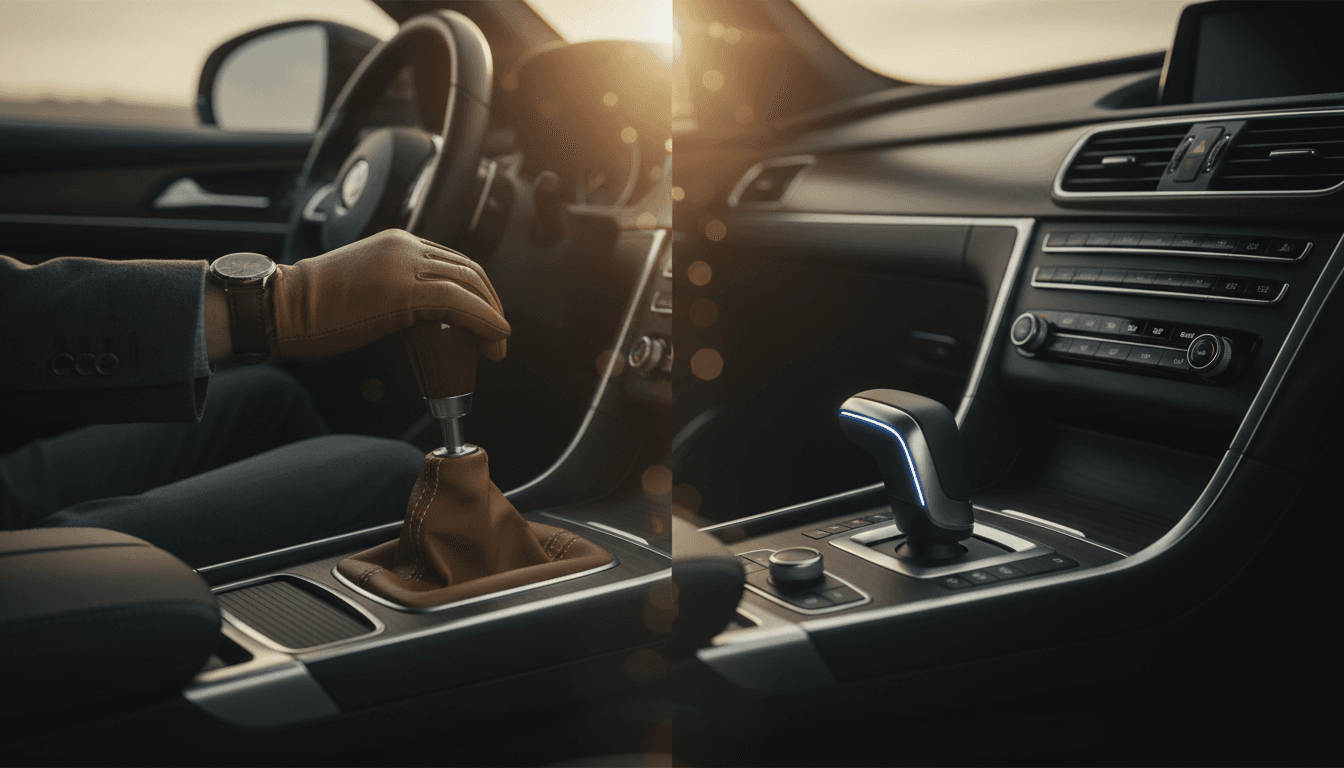
A manual puts the driver in charge: clutch, gears, the bite point. For many enthusiasts it still means control and involvement, especially on mountain roads or in sporty cars, where picking the right ratio is part of the fun. It also demands constant attention and a bit of coordination.
An automatic takes the clutch out of the equation. Both hands stay on the wheel, the drive is smoother and mentally less tiring. Modern gearboxes with 7, 8 or even 9 ratios are quick and clever, keeping the engine in its ideal torque band better than most drivers could. If you miss having a say, paddle shifters let you take manual control whenever you want.
Fuel economy: the gap has closed
For decades automatics meant higher fuel bills. That was true of the old 3- and 4-speed torque converters, which could drink 10-15% more. Not anymore. A well-tuned dual-clutch or 8-speed automatic often matches a manual, and in city driving it can do even better, because it shifts at the optimal moment and avoids the mistakes of a human foot.
The CVT, or continuously variable transmission, is among the most efficient in town and with hybrid engines, because it keeps the engine at its most economical speed. On open roads and motorways the difference between a manual and a modern automatic is now just a few percentage points: your driving style and the route matter more than the presence of three pedals.
What they really cost: purchase and upkeep
On a new car, an automatic typically adds 1,500 to 2,500 euros over the same model with a manual. On the used market that shows up as a higher starting price for the same year and mileage. It is the first thing to budget for.
Maintenance tells two different stories. A manual is mechanically simple: the typical expense is a clutch replacement, which runs from 400 to 1,200 euros depending on the car, usually after 120,000-150,000 km if driven with care. An automatic needs its transmission fluid changed at set intervals (for many dual-clutch units, roughly every 60,000 km), at a cost of 150-300 euros. Major repairs, such as a dual-clutch pack or a torque converter, can exceed 1,500 euros: rare, but pricey.
A note that matters in the Italian market: the type of gearbox does not affect the bollo (annual road tax) or the revisione (roadworthiness test). The bollo is based on power in kW and emissions class, and the revisione has a fixed fee. Your yearly fixed costs depend on engine size, power and fuel type, not on the pedals.
Reliability and resale value
On reliability, the manual starts ahead thanks to simplicity: fewer parts, less electronics, cheaper repairs that any workshop can handle. Modern automatics have improved enormously, but some early dual-clutch units had well-known issues, such as jerkiness at low speed and premature wear. With a used car, always check the service history and take a careful test drive, ideally with a trusted mechanic.
On resale, the wind has changed. In cities and premium segments automatics are increasingly in demand and tend to sell faster and hold value better. In sports cars, off-roaders and among keen drivers, a good manual keeps a loyal following. If you already have an eye on how and to whom you will sell, factor that in.
Comfort in the city, traffic and the ZTL
This is where an automatic shines. In stop-and-go traffic, among lights, queues and the constant pull-aways of historic centres and ZTL zones, not having to feather the clutch a thousand times a day cuts stress and fatigue. Pulling away uphill, there is no risk of stalling or rolling back. For anyone who racks up city kilometres, for nervous new drivers, or for people with a left-leg problem, it often transforms life on board. On flowing rural roads, and for those who love control, the manual stays enjoyable and rewarding.
The three main automatics (and who they suit)
Not all automatics are the same. Knowing the three big families helps you pick the right used car.
The dual-clutch (DSG, DCT and similar) uses two clutches to swap gears almost without interruption: very fast and sporty, ideal for anyone who wants sharp response and dynamic driving. It needs punctual maintenance and is less at ease in very slow traffic.
The CVT has no fixed gears but a ratio that varies continuously: wonderfully smooth and efficient, perfect in town and with hybrids. Under hard acceleration it can feel like the engine is revving without pushing, the so-called scooter effect, which not everyone likes.
The torque converter is the classic automatic, soft and robust, excellent on saloons, SUVs and for towing. It is very comfortable and generally long-lived, though not the sharpest at quick shifts.
Then there is the single-clutch automated manual (AMT), found on some budget city cars: cheap, but less smooth, with slower shifts. Try it thoroughly before buying.
A word about the licence
Historically, taking your driving test in an automatic earned a category B licence valid only for automatics, the so-called code 78. The rules have been revised over time, so if you are a new driver or still studying for your patente, check the current regulations with your driving school or the Ministry website before you choose. If you already hold a full B licence there is no restriction: you can drive either type freely.
In practice: how to choose
If you drive mostly in the city, in traffic and around ZTL zones, or you want maximum comfort with minimal effort, an automatic is almost always the right call: choose a torque converter or a CVT for smoothness, a dual-clutch if you also want sportiness. If you love driving, cover lots of open road, have a tight budget or want the simplest, cheapest maintenance, a good manual is still hard to beat.
Either way, on the used market the condition of the individual car matters more than the gearbox in the abstract: ask for the service history, check the clutch or the transmission fluid, and always take a test drive. And remember the fixed costs of buying used, such as the passaggio di proprietà (ownership transfer), which do not depend on the transmission at all. Once you know what you want, browsing the listings on VendiVoce and filtering by gearbox type is the fastest way to find the right car for you.
Further reading
- Automobile Club d'Italia — costi di gestione, bollo e servizi auto — ACI
- Quattroruote — prove, listini e tecnica dell'auto — Quattroruote
- Al Volante — guide all'acquisto e consigli sull'auto — Al Volante
- Motor1 Italia — attualità, tecnica e comparative auto — Motor1 Italia
- Ministero delle Infrastrutture e dei Trasporti — patente e normativa — MIT
Related articles
Dacia Spring vs Leapmotor T03: Which to Buy in 2026?
Price, range, charging and equipment for Italy's two most searched low-cost EVs, compared point by point, with a look at what to expect once they reach the used market.
Used Chinese Cars: Worth Buying in 2026?
Chinese brands are booming in new-car sales (+72% registrations in 2025) but stuck at just 3% of the used market. Here is what the data on resale value, warranty and reliability of MG, BYD, Omoda and Jaecoo really says before buying one secondhand.