Inherited Car in Italy: Transfer Ownership
What to do when a car's registered owner dies and there are several heirs: acceptance, the 60-day deadline, documents, delegations, costs, and the choice between co-ownership, one heir or a sale.
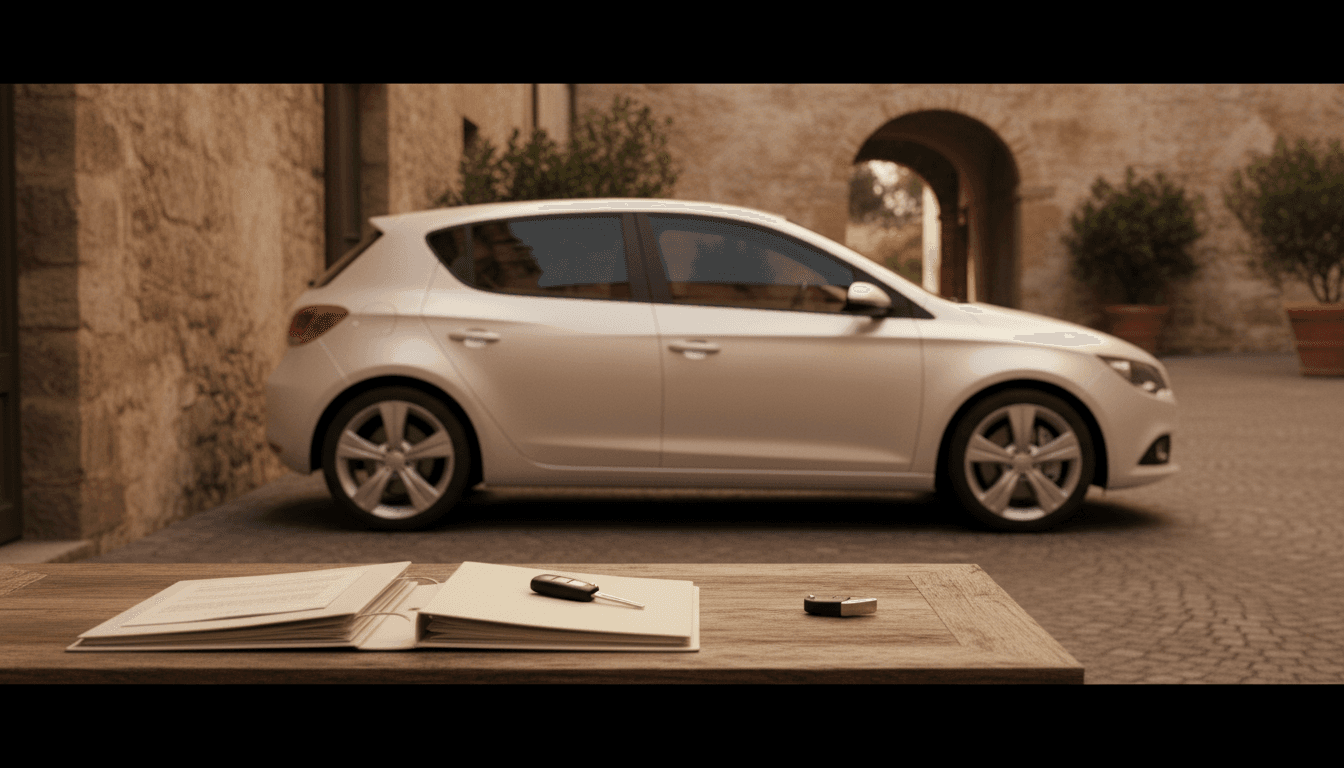
When the registered owner of a car dies in Italy, the vehicle does not pass to the heirs just because the estate opens: it stays in the deceased's name in the PRA (the national vehicle register) until a transfer is recorded. With several heirs the process needs a bit more care. This guide covers the order of steps, the documents, the 60-day deadline and what it costs.
Why the PRA transfer is needed
A car is a registered movable asset, so ownership is proved by the PRA entry, not by handing over the keys. The tax return for the estate filed with the Agenzia delle Entrate is a separate obligation and does not replace the PRA registration [4]. While the car stays in the deceased's name you cannot sell it, and problems can arise with insurance, administrative liens, roadside checks and the annual road tax.
Starting point: accepting the inheritance
The transfer rests on the heirs accepting the inheritance. According to Studio Cataldi, acceptance has to appear in a formal act (a public deed or an authenticated private agreement); tacit acceptance is not enough to update the registration, because there is no act identifying the heirs [1]. In practice the heir's signature on the acceptance is authenticated, for example by a notary or, as trade guides describe, at an STA (Sportello Telematico dell'Automobilista) [2][3].
The 60-day deadline
The number to remember is 60 days. It runs from the authentication of the heir's signature on the act: within that period the act must be registered at the PRA and the registration document (now the single document, or documento unico) updated [1][2]. So it is not a clock that starts automatically on the date of death; the acceptance act is what counts. That is no reason to wait months, though, since the car stays locked until the paperwork is done.
For delays, Studio Cataldi cites administrative fines of 705 to 3,526 euros for breaching article 94 of the Highway Code, and 353 to 1,762 euros for driving with documents that were not updated [1]. Trade guides add that late registration is still possible by paying the provincial transfer tax (IPT) with a 30% surcharge plus legal interest [3]. Fine amounts can be revalued, so always check the current figure.
Several heirs: three routes
This is where the case differs from a single heir. The options are:
- Register the car in all heirs' names. It becomes co-owned. It is the simplest step, but if one heir later wants to keep it or sell it, a second transfer is needed, with the costs paid twice [4].
- Register it directly to one heir. With the others' consent, they transfer or waive their shares and you reach the final owner in one go, which usually means fewer formalities.
- Sell to a third party. Guides explain that the acceptance is registered first with the car in all the heirs' names, then the sale of the shares; a single act combining acceptance and sale is also allowed [3].
If the car was co-owned with someone who is still alive, only the deceased's share passes to the heirs.
To avoid having every heir attend, one of them can sign the application if the others give written authorisation. If the act is authenticated directly at an STA, all heirs must appear in person [2].
Documents to prepare
The exact list depends on the office and the case, but you will normally need:
- the unified application and the PRA forms;
- the certificate of ownership (also digital) and the registration document or documento unico;
- the act of acceptance with authenticated signature (plus a copy or extract of the will, if there is one);
- a sworn statement (dichiarazione sostitutiva di atto di notorietà) confirming heir status;
- ID and tax code of the heir or heirs;
- a signed delegation from the other heirs if only one attends.
Non-EU heirs need extra papers such as a residence permit [2][3]. If an agency files for you, it will also need its own authorisation.
What it costs
The total varies by province because IPT is set locally and is due in inheritance transfers unless a specific exemption or reduction applies, for instance for people with disabilities or some historic vehicles [4]. The fixed items quoted by guides, which you should confirm in the ACI calculator because they have changed over the years, are:
- ACI fees: about 27 euros;
- stamp duty on the unified application: 32 euros, plus 16 euros for the documento unico (older guides quoted 48 euros for the PRA stamp);
- Motorizzazione fees: 10.20 euros;
- 16 euros stamp duty on the authentication, if the act is drawn up at an STA [2][3].
On top of that comes the fee of any car-paperwork agency, which has no public tariff. For a mid-value car the total is mostly decided by IPT, so ask for a written quote.
Renouncing the inheritance
Anyone who does not want the car, or the estate as a whole, can renounce. Under article 519 of the Civil Code the declaration is made before a notary or at the court registry [2]. A renouncing heir does not sign the acceptance or any delegation and does not need to attend the counter. Before renouncing, talk to a professional about debts and other assets, because renunciation covers the whole estate, not just the vehicle.
Practical checklist
- Establish who the heirs are and whether there is a will.
- Agree on who keeps the car, or whether it will be sold.
- Authenticate the signature on the acceptance and note the date: the 60 days start there.
- Gather documents and delegations before going to the STA or agency.
- Ask for a quote that includes IPT.
- Update the insurance and check the road tax, and only then think about selling.
Bottom line
With several heirs the rule is simple: register the acceptance first, then decide who gets the car or sell it. Doing it in the right order, within 60 days, avoids fines and double fees. If the goal is to sell, a clean registration makes the sale far easier, including on a marketplace like VendiVoce.
Further reading
- Studio Cataldi, La successione del veicolo.
- Sicurauto, Ereditare un'auto: costi, pratiche e rinuncia.
- Motorionline, Auto ereditata: cosa fare, iter e costi.
- Automobilista.it, Quanto costa il passaggio di proprietà di un'auto agli eredi nel 2026.
Further reading
Related articles

Buying a used car privately in Italy: steps and scams
How to buy a used car from a private seller in Italy safely: listing checks, PRA search, test drive, safe payment, bill of sale and the ownership transfer within 60 days.

Motorcycle Ownership Transfer in Italy: Costs
How a motorcycle ownership transfer works in Italy: documents, the 60-day deadline, ACI fees, stamp duty, province-dependent IPT, DIY versus agency, and mistakes to avoid.