Lewis Hamilton Is Restoring a Barn-Find Ferrari F40: What It Says About the Analog Supercar Market
The barn find brought back to life in Maranello is not just a paddock story: it is a signal of how analog Ferrari values are climbing, and what actually matters when buying a historic car in Italy in 2026.
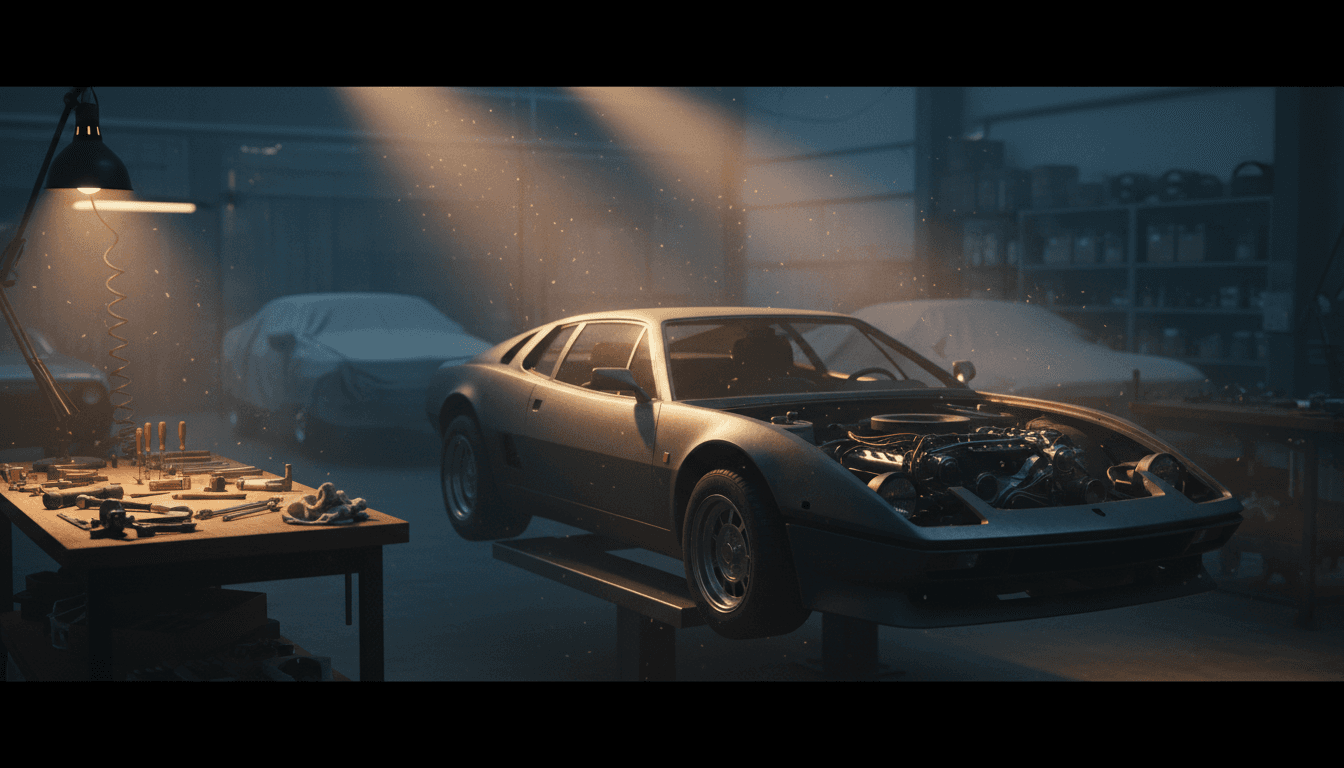
A Barn Find Worthy of a Film, and It Actually Happened
Late August 2026: Lewis Hamilton posted photos of a Ferrari F40 stripped down to its bones in Maranello's workshops, engine pulled, bodywork dusted off after more than three decades of sitting untouched. The seven-time Formula 1 world champion had sold his entire supercar collection just a year earlier, saying that if he kept only one car it would be an F40, a piece of art, as he put it [1][2]. Now he actually owns one, and it is not a showroom-fresh example. It is a barn find, a car left forgotten in a shed for decades, brought back to life by Ferrari's own official restoration division [3].
This is not just paddock gossip. It is a useful snapshot of where the market for analog supercars is heading, right as the rest of the industry races toward driver assistance and electrification.
The F40: The Last Ferrari Enzo Personally Signed Off On
The F40 launched in 1987 to mark the brand's fortieth anniversary, and it is the last road car Enzo Ferrari personally approved before his death in 1988. It is mechanical to the bone: a carbon-kevlar tub, a 3.0-liter twin-turbo V8 producing 478 horsepower, no power steering, no ABS, no interior trim beyond the essentials. Roughly 1,311 were built through 1992, a number that makes it less rare than some other collector Ferraris, but no less coveted: many collectors still call it the purest road-going Ferrari ever built.
What an F40 Is Worth Right Now
Prices remain out of reach for most drivers, but they are a useful gauge of where the high end of the used market is moving. Certified, well-kept examples now start around 1.9 to 2 million euros, with fully documented cars averaging 2.2 to 2.4 million [4]. Low-mileage cars with a clean, traceable history push past 2.5 million, and on the international market, in dollars, prices range from 2.5 to 4 million, with exceptional cars fetching 4 to 6 million or more [4]. On sites like Classic Trader and AutoUncle, some European listings currently ask as much as 2.8 million euros for individual cars [5].
What actually moves the needle here is not horsepower or paint color, it is provenance. Low mileage, documented service history from the first owner, and a clean accident record can be worth hundreds of thousands of euros on otherwise identical cars.
Ferrari Classiche Certification: Why It Matters More Than the Badge
For anyone getting close to this segment, the real line between a collector car and an expensive risk is the Ferrari Classiche Certificate of Authenticity. It is reserved for road-going Ferraris more than twenty years old and is only issued after a thorough inspection of the chassis, engine, gearbox, suspension, brakes, wheels, bodywork and interior, carried out by Ferrari technicians who cross-check the car against the original build sheets the company has kept since 1947 [6]. It is not a formality. It is proof that the car genuinely matches the specification it left the factory with, and in a market where replicas and heavily reconstructed cars do exist, that proof is what protects a buyer's investment.
For a car at this level, getting it certified, or confirming it already is, before signing anything is not a nice-to-have. It is the difference between buying a piece of history and buying a problem.
Road Tax, Inspections and Historic Registries: The Italian Rules for Buying a Classic
Set the eye-watering numbers aside, and the rules that apply to any historic car in Italy apply here too, not just to F40 owners. As of 2026, cars registered more than thirty years ago are automatically exempt from the annual road tax, known as the bollo, as long as they are not used commercially, and owners no longer need to be enrolled in a historic registry to claim it, though a flat circulation fee of roughly 25 to 30 euros is still due if the car is driven on public roads [7]. Cars between 20 and 29 years old pay half the standard bollo in nearly every region. Registering with a body like ASI, Storico Lancia, Italiano Fiat or Italiano Alfa Romeo is still worth doing: it opens the door to official events, historic plates, and often much cheaper dedicated insurance than an equivalent modern car would carry [7].
The Hamilton Effect: Why Analog Cars Keep Climbing
A story like Hamilton's does not move the market on its own, but it accelerates what is already happening. Every time a driver or a global celebrity puts a specific model in the spotlight, interest and search demand for that model, and for the whole family of similar cars, tends to climb in the following months. It has already happened to the F40 more than once thanks to documentaries and social media moments, and the same mechanism has recently pushed up prices for less extreme cars like the Testarossa or the 348, often described as the entry point into analog Ferrari ownership for buyers who cannot stretch to an F40 but still want a car with nothing electronic standing between them and the road.
For the used market more broadly, including Italy's, that translates into rising demand not just for museum pieces, but for honestly kept, clean-history Ferraris, Lamborghinis and Porsches from the 1980s and 1990s. Not million-euro trophies, but real, drivable cars that a serious enthusiast on a real budget can still afford.
What to Check Before Buying a Classic Supercar
Anyone considering a purchase in this segment, even one far more modest than an F40, should always check: complete service documentation going back to the first owner, a matching chassis number and registration document, certification from an official body where one exists (Ferrari Classiche or the equivalent for other marques), the true condition of the bodywork under any recent repaint, and an accident history check through Italy's PRA vehicle register. A car left sitting for years, as with Hamilton's barn find, almost always needs a full mechanical once-over before it is safe back on the road: seals, tires, brakes and fuel lines need checking even when the mileage looks low.
The Takeaway
Hamilton's F40 will not move the price of a used hatchback, but it is a clean snapshot of where the classic car market is heading: more demand, more attention to paperwork and certification, and a younger audience that increasingly sees analog cars not as museum pieces but as cars meant to be driven. For anyone in Italy who already owns, or is thinking about buying, a historic car at a far more accessible level, the basics stay the same: the paperwork matters as much as the paintwork.
Sources
- Read Motorsport, Lewis Hamilton Ferrari F40 Rescued And Reborn At Maranello
- Motor1.com, Lewis Hamilton Finally Bought His Dream Car: The Ferrari F40
- ESPN, Lewis Hamilton takes ownership of iconic Ferrari F40 road car
- QuotazioneAutoUsate.com, Quotazione Ferrari F40 usata
- AutoUncle.it, Ferrari F40 usata
- Ferrari.com, Ferrari Classiche: Certificazioni
- Automobilista.it, Esenzione automatica bollo per auto storiche oltre 30 anni
Further reading
- Lewis Hamilton Ferrari F40 Rescued And Reborn At Maranello — Read Motorsport
- Lewis Hamilton Finally Bought His Dream Car: The Ferrari F40 — Motor1.com
- Lewis Hamilton takes ownership of iconic Ferrari F40 road car — ESPN
- Quotazione Ferrari F40 usata — QuotazioneAutoUsate.com
- Ferrari F40 usata — AutoUncle.it
- Ferrari Classiche: Certificazioni — Ferrari.com
- Esenzione automatica bollo per auto storiche oltre 30 anni: cosa cambia dal 1 gennaio 2026 — Automobilista.it
Related articles
Classic Maserati Prices in 2026
A new Hollywood biopic and the Trident's 100th anniversary are reviving interest in classic Maseratis. Here is what a vintage Maserati actually costs in Italy today, from an entry-level Biturbo to collector-grade icons, and what buyers need to know about certification, historic plates and road tax.
Classic Lancia Gamma: What It's Worth in 2026
Lancia has revived the Gamma name for a new 2026 SUV. But what is the original 1976-84 Gamma actually worth today? History, known flaws, real prices, and a pre-purchase checklist.